B
Bama News
TideIllustrated - Reading between the lines of Alabama basketball's practice court
The Alabama basketball practice gym is littered with lines of blue painter’s tape.
 alabama.rivals.com
TUSCALOOSA, Ala. — The Alabama basketball practice gym is littered with lines of blue painter’s tape. While first-year head coach Nate Oats isn’t planning on making any in-season touchups to the floor, he would like to better illustrate how he wants his players to see the court.
During practice, that process includes a series of zones and boundaries drawn to better accustom his team to his style of play.
The first thing that catches the eye is an over-sized 3-point line Alabama refers to as its “4-point line” which sits roughly three feet back from the college line. While it’s not uncommon for Crimson Tide players to spot up from the new boundary during practice, Oats says the marker is meant more for spacing purposes.
“You kind of have steppers and huggers. We don’t want our guys hugging the 3-point line, we want them stepping into the 3-point line on the catch,” Oats explained. So if they’re behind the 4-point line then they step into the 3-point line.”

Staying beyond the arc, there are two large rectangles near the wings. These are also used for spacing as they force the Crimson Tide out wide, spreading out opposing defenses even more to create room to either set up the post position or cut inside for drives.
“We call it the Houston spots,” Oats said. “You kind of watch where James Harden brings the ball up here. They space that far wide on the floor.”
Alabama has also placed Xs roughly three feet from the courtside, creating a lane for the wing players to run in transition. This further hammers home the importance of staying wide. Those lanes lead to rectangles in the corners where players are instructed to sprint to in order to further open up the court.
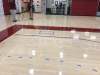
Working our way inside the arc, there’s a dotted line that Oats refers to as the "2-point line." This is more of a defensive reference as Alabama defenders will move inside the area to crowd the post and prevent easy baskets.
“That’s like a pack line where if your guy doesn’t have the ball your packing in off your guy,” Oats said. “We’re going to try and load up and shrink the floor and not allow triple penetration by getting in there.”
Finally, there are two sets of boxes near the baseline with the bigger one encompassing the smaller. Oats explained that the larger box is used as a defensive reference as a no-catch zone for teams who post up more. The smaller is meant for the offense as a zone where Alabama’s bigs are positioned for low-post scoring opportunities.
“We call that the dunker spot,” Oats said. “We’re looking for drop-offs. We’re not doing a very good job getting them there currently.”
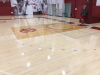
Oats admits a lot of the new concepts haven’t completely sunk into his players. The head coach said his team is “nowhere close to where we want to be” and stated that the imaginary reference points often get forgotten while going against actual competition during games.
Oats said Alabama has moved to more non-live drills the past two days of practice as he looks to instill more fundamentals and skill components. While the process will take some time, his team seems to be buying in.
“It gives you an imaginary line in the game so you automatically know where to run to,” point guard Kira Lewis Jr. said. “When they drill it in your head so many times, it’s just like second nature.”
Added forward Javian Davis: “It helps just knowing where to be at in the right spot. Just being right there for my guards to find me and just spacing the floor.”
Alabama will fly to the Bahamas on Monday as it takes part in the Battle 4 Atlantis tournament. The Crimson Tide (2-2) will face No. 5 North Carolina (4-0) on Wednesday at 1:30 p.m. CT on ESPN. The winner of the game will play the winner of Michigan vs. Iowa State the following day with the losers also set to meet in the consolation bracket. The tournament will come to a close with another game that Friday.


