You are using an out of date browser. It may not display this or other websites correctly.
You should upgrade or use an alternative browser.
You should upgrade or use an alternative browser.
🏀 🏀 2025-26 Bama Basketball Updates: Roberts recuses himself: Judge Daniel Pruet has a decision on his hands
- Thread starter Brandon Van de Graaff
- Start date


Can’t we just send Noah Williamson to the Pistons and call it even?
I like your line of thinking. Just as easy to sit the bench in Detroit as it is in Tuscaloosa.

Last edited:

None of this has been an issue or debated until Alabama was thrown into the mix. Now, the NCAA and every other basketball talking head has their panties in a twist with about “how wrong it is and the disservice being done to HS athletes” blah blah blah.
Piss on the NCAA. Maybe this will blow their shit up once and for all. They have constantly moved the goalposts, granting this one but denying that one when their cases are exact almost to the letter.
I’m not crazy about Bediako suiting up for us, but damn, we might as well even the playing field.
Piss on the NCAA. Maybe this will blow their shit up once and for all. They have constantly moved the goalposts, granting this one but denying that one when their cases are exact almost to the letter.
I’m not crazy about Bediako suiting up for us, but damn, we might as well even the playing field.
Beware Cleveland State, NZAA is mad!! Remember they got so mad at Kentucky one time, they gave Cleveland State 3 years probation.None of this has been an issue or debated until Alabama was thrown into the mix. Now, the NCAA and every other basketball talking head has their panties in a twist with about “how wrong it is and the disservice being done to HS athletes” blah blah blah.
Piss on the NCAA. Maybe this will blow their shit up once and for all. They have constantly moved the goalposts, granting this one but denying that one when their cases are exact almost to the letter.
I’m not crazy about Bediako suiting up for us, but damn, we might as well even the playing field.

Can’t we just send Noah Williamson to the Pistons and call it even?
I like your line of thinking. Just as easy to sit he bench in Detroit as it is in Tuscaloosa.

I've questioned "is it just me" or "is it because of the algorithms" or ...None of this has been an issue or debated until Alabama was thrown into the mix.
Then I also realized that the guys I'm seeing the "angst" from are those I follow on different outlets. I did see a little about Baylor; nothing to this extent. The guy at Santa Clara? Nothing. BYU? Nothing.
Same guys, right? So yes, there is more here which leads to this question:
Why? Why is a guy like Pete Thamel talking about Bama basketball all of a sudden? ESPN Senior College Football Writer (replaced Low) is talking about basketball eligibility in this basketball season while he is technically on vacation?
Why was there so much attention paid to the Brandon Miller story?
I've entertained this idea a few times. These folks were so tired of writing and hearing about Alabama and the success of the football program that seeing Oats have his success was a bit too much. Then we had Brandon Miller which gave the opportunity to bitch (in spite of not knowing or finding out details of the story.)
Now, here we are again. It the football program the true culprit? This wouldn't be in the news if it were a different athletic department.
I'll suggest if this was happening with Curry and WBB they would treat her differently than they have Dawn Staley: who also has a professional on her roster.
I believe I've learned you are older than I am. So, I am hoping you realize how ironically funny this is.Beware Cleveland State,
That probation with CSU happened just after I got out of high school; late 80's. One of the issues the COI had was CSU staff member recruiting a foreign guy. Two actually, that they had flown in. So, talent out of the country playing NCAA basketball was an issue for awhile, right?
There were academic issues. I can't pull the name...Minute, Minite...Bow, Boa, Boe...played pro ball after college. Bol. That's the last name. HE couldn't speak English so how was he academically eligible? The COI didn't think he was: another foreign guy.
Thankfully, Tua could speak English.

This entire thing sucks. It's dumb. It's another stupid dried up log on the already out of control fire that is turning the college athletics landscape to ashes. But, at some point, the ridiculousness of it all has to reach a breaking point. Until then, nothing will be done about any of it and the fire will just keep burning. This Bediako thing is the next step to burning down the barrier between lack of rule enforcement and complete chaos. The NCAA backed themselves into a corner (as they tend to do) when they allowed professional "foreign" players to be eligible to play.
As an aside... Personally, I've never been a fan of how the NCAA has let some foreigners use the system to come over here under the guise of being a "student" athlete when their only goal is to benefit from US coaching, facilities, training, etc. And that goes for ALL NCAA sports, not just basketball. Go pull up a random school's swim team or golf team and see how many are from overseas. America's colleges basically serve as the rest of the world's summer and winter olympic training HQ's. The NCAA wants to talk about taking away scholarship opportunities from HS athletes? They have allowed non-citizens to eat them up for years. The only thing more egregious on that front is the fact that while they want to bitch about it now, it was/is their main source of punishment to schools who colored outside the lines... take away scholarships. Punish some HS athletes because a now fired football coach broke some recruiting rules. But their concern is taking away scholarships? Which the Bediako case isn't even doing? Makes sense.
Anyway, back to the Bediako circus... When they allowed "professionals" to be eligible, they opened a door that they can't police. The judge yesterday basically said you can't allow one set of professionals to play and not another. And from what I understand (I don't follow overseas basketball). but many of these foreign and European leagues that some of these college players have come from are better, higher skilled, and more professionally competitive leagues than the G League here in the US.
Yes, it's dumb. In a common sense world, Bediako would have forfeited his remaining college eligibility when he decided to leave early and turn pro (after a set deadline). But it's equally as dumb, if not worse, that the same standard isn't applied to the foreign professional players. You're either a professional, or you're not. And professionals should or shouldn't be allowed to play in college. That is what is boils down to. So while I'm against pros (like Bediako) being allowed to play college basketball, I'm also happy that it is happening. The obvious boost to the team aside, it is serving a great purpose in making a mockery of the system that the NCAA has created (not all their fault, but most of it is). And every coach that speak out about it, like Pearl or Pope, who has a former European player on their roster, will be doing so from a hollow branch on the hypocrisy tree. And I'd imagine that when pressed, Nate Oats will specifically point that out.
As an aside... Personally, I've never been a fan of how the NCAA has let some foreigners use the system to come over here under the guise of being a "student" athlete when their only goal is to benefit from US coaching, facilities, training, etc. And that goes for ALL NCAA sports, not just basketball. Go pull up a random school's swim team or golf team and see how many are from overseas. America's colleges basically serve as the rest of the world's summer and winter olympic training HQ's. The NCAA wants to talk about taking away scholarship opportunities from HS athletes? They have allowed non-citizens to eat them up for years. The only thing more egregious on that front is the fact that while they want to bitch about it now, it was/is their main source of punishment to schools who colored outside the lines... take away scholarships. Punish some HS athletes because a now fired football coach broke some recruiting rules. But their concern is taking away scholarships? Which the Bediako case isn't even doing? Makes sense.
Anyway, back to the Bediako circus... When they allowed "professionals" to be eligible, they opened a door that they can't police. The judge yesterday basically said you can't allow one set of professionals to play and not another. And from what I understand (I don't follow overseas basketball). but many of these foreign and European leagues that some of these college players have come from are better, higher skilled, and more professionally competitive leagues than the G League here in the US.
Yes, it's dumb. In a common sense world, Bediako would have forfeited his remaining college eligibility when he decided to leave early and turn pro (after a set deadline). But it's equally as dumb, if not worse, that the same standard isn't applied to the foreign professional players. You're either a professional, or you're not. And professionals should or shouldn't be allowed to play in college. That is what is boils down to. So while I'm against pros (like Bediako) being allowed to play college basketball, I'm also happy that it is happening. The obvious boost to the team aside, it is serving a great purpose in making a mockery of the system that the NCAA has created (not all their fault, but most of it is). And every coach that speak out about it, like Pearl or Pope, who has a former European player on their roster, will be doing so from a hollow branch on the hypocrisy tree. And I'd imagine that when pressed, Nate Oats will specifically point that out.
This is from College Football Nerds:
An attorney's explainer of the Bediako eligibility ruling: this is actually a small step stemming from a number of bad, inconsistent decisions regarding semi-pro players.
Let me say up front, my opinion is that none of these semi-pro players should be playing. This is bad for college sports, and this suit is another bad move toward making that harder to stop. But that doesn't make the suit wrong or unfair as a matter of law.
It's important to understand why Bediako won the TRO (and will likely win an injunction next week): the NCAA has been chipping away at enforcing its own rules regarding semi-pro players for years, especially those abroad, and it makes making Bediako ineligible an "arbitrary and capricious" decision in view of others that is open to judicial review to be overturned.
The NCAA (not a judge) granted eligibility to Baylor's Nnaji, who played for premier Euro team FC Barcelona after being the 31st pick in the NBA draft but not signing with a team. As another example, the UConn AD came out saying that Bediako's wins shouldn't count for the tourney, but at the same time UConn just signed and is now playing with two Euro players including Uroš Paunović, who spent the last 4 years playing for Serbia's top professional division. Alabama's main rival, Auburn, signed Filip Jović with 2 years professional experience in Bosnia. All of these players are 21-23 years old at enrollment (often as "freshman"). The hypocrisy of everyone involved (Alabama, UConn, the NCAA, etc.) is just absurd.
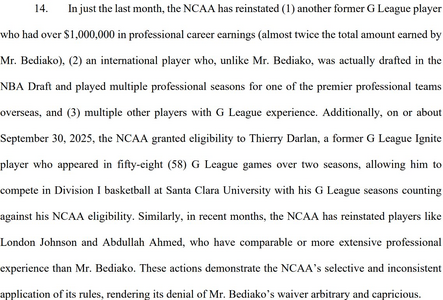
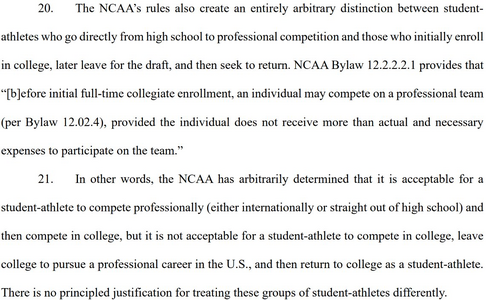
As to the legal basis, two snippets from Bediako's complaint are below for reference - the NCAA's continued refusal to follow their own rule that "an individual may compete on a professional team (per Bylaw 12.02.4), provided the individual does not receive more than actual and necessary expenses to participate on the team," by ignoring when players get $1M plus in "semi" professional basketball, opened the door wide for a lawsuit. As the complaint notes, if a player can be drafted and play two years later, or play professional ball in Europe for four years before enrolling, why can a Canadian playing American basketball who enters the draft and goes undrafted not come back when he is otherwise still within his 5 year eligibility window?
The lawsuit itself is a state suit that alleges a restraint on trade and interference with contracts, among other things, based on an arbitrary and capricious application of NCAA rules. A temporary restraining order (TRO) was granted, which is generally based on whether there is an "irreparable harm" and whether there is a "likelihood of success on the merits" in the full suit. That TRO expires next week, but that is tied to a hearing for a preliminary injunction which I would expect to be granted given that the TRO was granted under the same facts.
As we've said in prior tweets, the NCAA is essentially a trade union - they have no real legal backing and are thus totally at the mercy of all state laws and rulings. The TRO includes a strongly worded provision against punishing "or implying to punish" Bediako or Bama for the ruling, so the NCAA is completely bound by the order absent appeal. Even if the ruling is reversed, a retroactive punishment would almost certainly be viewed as contempt of court (violating an order later overturned is generally still contempt), so ignoring the order would potentially open the NCAA up to massive liability. The only real way to supersede these rulings would be if we pass a federal law granting the NCAA legal power to enforce basic eligibility rules.
This is just my personal opinion, but as a legal matter I think the NCAA is responsible for digging their own grave here and the legal basis for Bediako's claim is reasonable. If the NCAA doesn't want Bediako to play, they need to also bar Nnaji, Paunović, and Jović, as well. The NCAA can make this a "one-time" deal, but to do so they need to start enforcing rules across the board. With NIL, state laws in California and Florida "broke" NCAA rules, but in both instances the NCAA had a chance to create reasonable rules and enforce them consistently, and their failure to do so is the ultimate reason this happened - not the lawsuits.
I just don't see how the NCAA can argue that European professional basketball players can be a 22 year old freshman with no issue, but an American player who enters the draft and goes undrafted can't. NONE of these players should be able to play - but the line the NCAA has tried to draw seems legally untenable.
An attorney's explainer of the Bediako eligibility ruling: this is actually a small step stemming from a number of bad, inconsistent decisions regarding semi-pro players.
Let me say up front, my opinion is that none of these semi-pro players should be playing. This is bad for college sports, and this suit is another bad move toward making that harder to stop. But that doesn't make the suit wrong or unfair as a matter of law.
It's important to understand why Bediako won the TRO (and will likely win an injunction next week): the NCAA has been chipping away at enforcing its own rules regarding semi-pro players for years, especially those abroad, and it makes making Bediako ineligible an "arbitrary and capricious" decision in view of others that is open to judicial review to be overturned.
The NCAA (not a judge) granted eligibility to Baylor's Nnaji, who played for premier Euro team FC Barcelona after being the 31st pick in the NBA draft but not signing with a team. As another example, the UConn AD came out saying that Bediako's wins shouldn't count for the tourney, but at the same time UConn just signed and is now playing with two Euro players including Uroš Paunović, who spent the last 4 years playing for Serbia's top professional division. Alabama's main rival, Auburn, signed Filip Jović with 2 years professional experience in Bosnia. All of these players are 21-23 years old at enrollment (often as "freshman"). The hypocrisy of everyone involved (Alabama, UConn, the NCAA, etc.) is just absurd.
As to the legal basis, two snippets from Bediako's complaint are below for reference - the NCAA's continued refusal to follow their own rule that "an individual may compete on a professional team (per Bylaw 12.02.4), provided the individual does not receive more than actual and necessary expenses to participate on the team," by ignoring when players get $1M plus in "semi" professional basketball, opened the door wide for a lawsuit. As the complaint notes, if a player can be drafted and play two years later, or play professional ball in Europe for four years before enrolling, why can a Canadian playing American basketball who enters the draft and goes undrafted not come back when he is otherwise still within his 5 year eligibility window?
The lawsuit itself is a state suit that alleges a restraint on trade and interference with contracts, among other things, based on an arbitrary and capricious application of NCAA rules. A temporary restraining order (TRO) was granted, which is generally based on whether there is an "irreparable harm" and whether there is a "likelihood of success on the merits" in the full suit. That TRO expires next week, but that is tied to a hearing for a preliminary injunction which I would expect to be granted given that the TRO was granted under the same facts.
As we've said in prior tweets, the NCAA is essentially a trade union - they have no real legal backing and are thus totally at the mercy of all state laws and rulings. The TRO includes a strongly worded provision against punishing "or implying to punish" Bediako or Bama for the ruling, so the NCAA is completely bound by the order absent appeal. Even if the ruling is reversed, a retroactive punishment would almost certainly be viewed as contempt of court (violating an order later overturned is generally still contempt), so ignoring the order would potentially open the NCAA up to massive liability. The only real way to supersede these rulings would be if we pass a federal law granting the NCAA legal power to enforce basic eligibility rules.
This is just my personal opinion, but as a legal matter I think the NCAA is responsible for digging their own grave here and the legal basis for Bediako's claim is reasonable. If the NCAA doesn't want Bediako to play, they need to also bar Nnaji, Paunović, and Jović, as well. The NCAA can make this a "one-time" deal, but to do so they need to start enforcing rules across the board. With NIL, state laws in California and Florida "broke" NCAA rules, but in both instances the NCAA had a chance to create reasonable rules and enforce them consistently, and their failure to do so is the ultimate reason this happened - not the lawsuits.
I just don't see how the NCAA can argue that European professional basketball players can be a 22 year old freshman with no issue, but an American player who enters the draft and goes undrafted can't. NONE of these players should be able to play - but the line the NCAA has tried to draw seems legally untenable.
 |  |


Bammerboy321
Member

Justneedme81
Member
This is way off topic but I had this game on at work in the background. Pay attention to Oats the first few minutes of the game. Dude definitely gets animated, but have we seen this version of Oats since this game? This guy ripping into everyone. It's no wonder we blew them out.
He did same thing last year.
Bammerboy321
Member
He has had moments where he is really animated. We've seen him really ride the officials before. Saw him first hand get heated with Charlie Henry in the Gonzaga game because we couldn't stop Drew Timme. But that SECT game was really the first I've seen him that intense from start to finish. It was really just him challenging the guys.He did same thing last year.
While Coach Oats provided his perspective earlier today on Charles Bediako and the process of him becoming eligible to compete for the Crimson Tide, I wanted to follow up with some additional thoughts. I think it’s safe to say the majority of us have concerns about the state of college athletics and are all for uniformity versus inconsistencies.
There are many programs across the country with former G League and EuroLeague players on their rosters who have been deemed eligible. At the end of the day, these are men with professional basketball experience that are now playing in college. The distinctions between those cases and Charles’ situation are without real differences. A professional contract should be a professional contract. Why should a student-athlete who earned millions competing professionally overseas be eligible to return to college, while someone earning $50,000 annually in the NBA G League is not? Similarly, an athlete who leaves high school for professional basketball returning to college later is okay, while a student who entered the draft during college, perhaps based on incomplete or poor advice, may be barred. These distinctions are impossible to explain, undermine confidence in the system and do not meaningfully advance the educational mission of college athletics.
That said, we must remain competitive and act in the best interest of our teams. As Coach Oats stated, Charles is still within his five-year window, is 23 years old and started classes again this semester to work towards degree completion. He’s also not taking away any opportunities from a high school prospect or anyone else with there being a vacant roster spot.
If this particular case can help shape the future of the sport, and better regulation of college athletics as a whole, we welcome that.
Just got home from a Publix run and had to share this... I get in the truck and the radio was on the B'ham sports station. Before I could switch it to bluetooth to play something else, I heard the name Bediako and it made me stop. I have no idea what show it was other than It was a national show... I assume ESPN radio but maybe not. The show host gives a quick rundown of the Bediako situation and then asks a female co-host (or guest?) what she thinks about it. The lady starts hammering away, talking about how bad it is for the sport (ok, not wrong there). But then she says, I could understand it if this was a player that entered the draft early and didn't get drafted... but then keeps on about how this should have been denied and it's definitely wrong. They moved on to the next topic and I swapped over to music, but it's funny to me that everyone has a strong opinion of this case and very few understand the facts or have enough deductive reasoning to be able to even dive into it.
-
Thread 'Spring Practice 2026: Reports and Update'
Practice (#5) resumes next week following spring break- Justneedme81
- Replies: 67
-

Thread '⛈ The weather thread. The south is waking up and spring work has begun'
What's on your 'project list' for '26?- bamaledge
- Replies: 352
-
🏈 - 2026 Alabama Roster Management Chart and Portal news
The latest on who's in and who's out.- Brandon Van de Graaff
- Replies: 1,655
-

-
Thread 'Anybody watched any good new shows or series lately?'
The off-season "blues." What to watch?- Brandon Van de Graaff
- Replies: 207


