I had a tee shirt that said "The Tide Can't lose in Baton Rouge." We had a 30 game winning streak at one time. Bama doesn't mind playing them at night.
Here's a story from 2010:
Alabama looks to keep Tide rolling in Baton Rouge
Nov. 2, 2010
The year was 1987. Bill Curry's first
Alabama team was about to take the field against
LSU in Baton Rouge.
Curry had launched into his extensively prepared pregame speech about the importance of the game, the significance of this great rivalry and the hostile atmosphere his players were about to face. Curry was about to hit his second set of talking points when a big old offensive lineman raised his hand.
"Hey, coach. It's OK. We got it," the big man said.
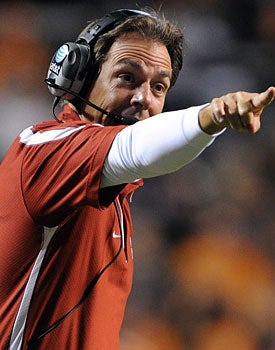
Nick Saban won a national title at LSU, but is unpopular in Baton Rouge for obvious reasons.(US Presswire)
Then the big fella paused for just a second: "Tide don't lose in Baton Rouge."
"And you know what? He was right," said Curry, now the head coach at the fledgling new program at Georgia State.
On Nov. 4, 1987, LSU was undefeated and ranked No. 5. Alabama was No. 13, but the Crimson Tide won 22-10. It would be the only game LSU would lose all season. Two years later, Curry would bring Alabama back to Baton Rouge. This time Alabama was ranked No. 4 and won 32-16. There is a tangible reason that a phrase like "Tide don't lose in Baton Rouge" comes into existence over time. From 1971 to 2000, a span of 30 seasons, Alabama did not lose at LSU's Tiger Stadium, one of the toughest venues for a visitor in all of college football. In those three decades, the Crimson Tide were 14-0-1 in Baton Rouge, the tie coming in 1985 (14-14).
That tie, by the way, remains one of the most infamous moments during the Alabama streak. In that game, Alabama coach Ray Perkins had so much respect and reverence for The Crimson Tide's record of success at LSU that he chose to kick the extra point and tie the game when Alabama scored with only 1:24 left. LSU had a chance to win, but Ronnie Lewis missed a 24-yard field goal with only five seconds left.
Alabama fans were not particularly happy with the decision. After all, by now they EXPECTED to win in Baton Rouge. But Perkins said emphatically after the game that he went for the tie because he could not bear the thought of an Alabama team losing at Tiger Stadium. That string of success just meant too much to Alabama.
"I wanted to give our team the chance to walk off the field a non-loser," said Perkins, who also felt the tie would keep him in the hunt for the SEC championship.
"It is really one of the most interesting anomalies in all of sport," said Keith Dunnavant, the Editor In Chief of crimsonreplay.com, a website dedicated to the vast and colorful history of Alabama football. "A number of those wins came in the 1970s when Coach [Bear] Bryant was beating just about everybody. But given how tough a place Tiger Stadium has been to play over the course of time, for Alabama to have that kind of sustained success is a real oddity."
Alabama's complete dominance at Tiger Stadium finally came to an end in 2000, but the man responsible for it only added another layer to an already rich rivalry.
Nick Saban left Michigan State to build the football fortunes at LSU. On Nov. 4, 2000, Alabama arrived in Baton Rouge as the defending SEC champion. LSU won 30-28. In 2002, however, his LSU team was thumped by Alabama 31-0 at Tiger Stadium. In 2003 Saban won a national championship at LSU (which included a 27-3 win at Alabama), and in 2004 Saban beat Alabama again in Baton Rouge 26-10.
In 2005 Saban left LSU for the Miami Dolphins and Tigers fans thought they had seen the last of him. But they did appreciate that he had won a national championship and ended the long home losing streak to Alabama.
Little did they know that two years later he would return as the head coach of the hated Crimson Tide. Some LSU fans saw it as the lowest form of betrayal. The reality was that Saban later told friends that leaving LSU and college football was the biggest career mistake he ever made. When he made it clear he wanted to come back to college football, the Alabama job was open and the powers that be were willing to pay him an unprecedented $4 million per year over eight years.
"I always hoped that people would not take it personally at LSU," said Saban. "We still have a lot of dear friends in Baton Rouge."
But this being the SEC, fans ALWAYS take it personally. The first season, 2007, LSU went to Tuscaloosa and had the satisfaction of beating Saban 41-34 on the way to a national championship. In 2008, Saban made his return to Baton Rouge and knew what lay ahead of him.
"I will probably have to take the bus to the stadium by myself because no one will ride with me," joked Saban.
Saban revived the old Alabama magic in Baton Rouge and won 27-21 in overtime.
What does it all mean? It means that since 1971, Alabama is 16-3-1 at LSU's Tiger Stadium. This Saturday, Alabama arrives in Baton Rouge as the defending national champion. The Crimson Tide (7-1) are ranked No. 6 in the BCS and need a win to keep their hopes alive of capturing another title. LSU (7-1) is ranked No. 10 and the Tigers' only loss was to No. 2 Auburn. If LSU can pull off the upset, then they still have an outside shot of winning the SEC championship and maybe getting in the hunt for the BCS title. But just as important to LSU fans is that its Tigers would have beaten Alabama at home and denied Saban a chance to win it all.
"Given where the game falls on the schedule, there is almost always going to be something on the line for one of the teams," said Dunnavant. "What's interesting is that this game is probably Alabama's third biggest rival behind Auburn and Tennessee. But there always seems to be some kind of drama when these two play."
http://www.cbssports.com/collegefoo...ama-looks-to-keep-tide-rolling-in-baton-rouge


 -) moving target) team at home most every year, when you consider the 2:30pm games (at least they did in 2005, 2007 (2), 2008, 2010, 2011, 2012, and 2014) . I was incorrect in recalling if some games were at night or not.


