🏈 The Camps -- SEC now has four schools in one "Mega-Camp."

A dated report (2008) but interesting...

Georgia Tech had the nation's best average SAT score for football players, 1028 of a possible 1600, and best average high school GPA, 3.39 of a possible 4.0."

I wonder where GT was getting all those smart football players, must be a national recruiting powerhouse.

Interestingly enough, even with only one year of increased special admits included under the Harbaugh regime, Stanford wasn't a top 10 school or even the highest rated Pac 12, CA-based school in the report for football player test scores.

Athletes Show Huge Gaps in SAT Scores
 
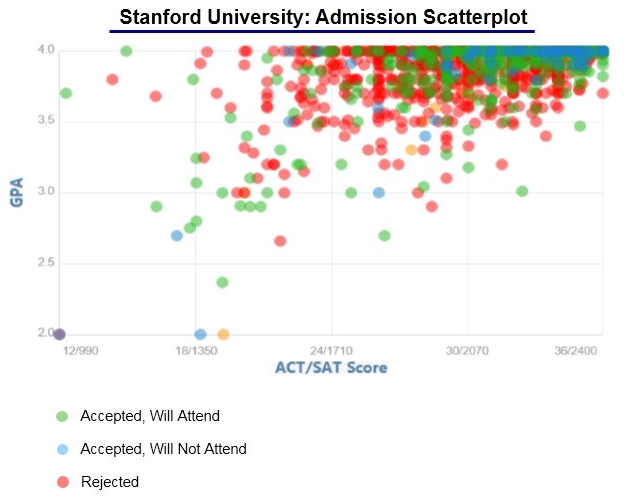
I'm willing to bet those green dots to the left side of the graph are heavily weighted toward the student-athlete special admission side of the student body.

Stanford-University.jpg
 
Harbaugh did assist in lowering the admissions requirements, as they were crazy high prior to him being the coach. Shaw has benefited from this.

Shaw apparently forgot about the easy class list for athletes, Stanford athletes had access to list of ‘easy’ courses.

He's trolled SEC fans via an assist from ESPN.

See the report I linked. Even when "crazy high" they trailed at least 3 Pac schools. Stanford is an extraordinary academic school, but their touted top student-athletes even before the Harbaugh effect weren't in the top 20% of the 54 team sample size in 2008.
 
Very interesting considering NASA has locations in Alabama, Florida, and Texas.

Growing up in Huntsville, I know that a lot of the kids I went to school with (whose parents worked for NASA) were 'transplants.' I get what Greg is trying to say, but I can't say it's really a good retort. That's not even bringing in Redstone as part of the reason.

To me, it's like saying Mercedes built their plant on 20/59 due to the Engineering programs in state when it reality a lot had to do with tax incentives.

What really flies in the face of what he's saying here is found at the following link:

Football - Roster - GoStanford.com - Stanford University

FL, SC, GA, TN (and recently signed McElwain from Hewett Trussville) are all on the roster. The only states not represented are Arkansas and Mississippi—hardly states where they were going to have camps in the first place.
 
Yet, in 2015 they boasted a 99% GSR

Generally speaking, I'm a fan of the FGR vs the GSR. Having said that, they still have a very high FGR.

Just find it odd that every junior and every sophomore on their roster has an undeclared major on the official roster page. There are no freshman on the page, so they at least keep it updated. Others sports they don't have 100% of sophomore and junior's as undeclared. Does the football team have a different policy or a more lenient policy that assist in the graduation rate success...
 
CECIL HURT: Satellite ruling won't cause loss of scholarships
Cecil Hurt | Sports Editor

vqwvuu90olom8qzatkxz


Last year, 127 schools fielded football teams in the NCAA's Football Bowl Subdivision (FBS), according to the NCAA's official website.

Now, let's assume that each one of those schools signed 23 players to scholarships last February just as a round number. The maximum number of signees per year is 25 but there were some schools, surely, who signed less than that because of the overall 85 limit. So, using those estimates, let's assume that there were 2,921 players signed to scholarships on National Signing Day.

Now, though, we don't have satellite camps allowing programs to host one-day recruiting events all over the country or, to be precise, in those areas of the country with the most college football prospects. No one, after all, is hosting a satellite camp in Fargo. So, given that catastrophic development, let's venture a guess as to how many players will be signed when the next signing day rolls around.

If you guessed 2,921, you nailed it.

For all the hand-wringing about the "loss of opportunity" that will accompany an NCAA decision voted on by the conferences, not handed down in a fiat from a faceless bureaucracy in Indianapolis, the fact is that not one school -- not Michigan, not Central Michigan -- is going to sign 18 players instead of 23 because they didn't have a satellite camp. It's possible that camps might uncover a "hidden" prospect here or there, but if there is a diamond in the rough in Tampa, he's probably getting a scholarship that would have otherwise gone to a diamond in the rust in Toledo. In the big picture, the game is zero sum.

That, of course, doesn't fit into lurid headlines. On the other hand, short, punchy words and acronyms like "NCAA," "SEC" and "Saban" fit nicely, draw eyeballs and clicks and are sure-fire fuel for a red-hot take.

Here is the other fact: it wasn't just the SEC who voted for the ban. It was every one of the Power Five conferences with a member school in either Florida, Texas or California. The five smaller conferences split differently on economic grounds, primarily, but the majority vote was for the ban. Why? Because schools voted for the self-interest. The SEC, ACC and Pac-12 voted the way that they thought best served their interests and so did the Big Ten and the MAC. That's what happens in a democracy, more often than not.

Now, having dialed back the hysteria meter by about 80 percent, I will say this. I agree with Nick Saban that the camps were largely publicity vehicles that big schools would eventually have gotten away from because they didn't bring a very good return on investment, other than brand-promotion and, in some instances, forging relationships with high school coaches working the camps.

On the other hand, I do think a school should have the right to spend its resources -- and the manpower of its frazzled assistants -- as it chooses. Perhaps some compromise can be reached in the future, and the one real benefit -- the chance to chase a dream and maybe see a famous coach -- can be restored. After all, as one national writer asked, what's wrong with that? Not a thing, just as there was nothing wrong with head coaches being able to do on-campus evaluations before the NCAA members doused that with "the Saban rule" in 2008.

If we're doing things "for the kids," maybe there are better crusades, like increasing the number of football scholarships from 85 to 90, or raising the penurious 11.7 limit in baseball up to 15. That would mean actual financial aid for about a thousand extra baseball players, who are also "kids." Make corresponding moves in women's sports and that's a thousand more "kids" being helped.

Of course, that doesn't fit as neatly into a headline.
 
Assuming Shaw wanted to be a coach when he was in college, a major in Sociology isn't a bad choice.
Let's not allow Auburn's Sociology program paint Stanford in the same light.

Perhaps. But, according to the latest statistics that Stanford will make available, 3% of their students who have declared a major did so in something called Science, Technology and Society (the sociological marker here being the "and Society" part). In contrast, the proportion of Stanford football players majoring in this program is 26.6% -- i.e., nine times that of the general student population. One has to set the Hmmm bar pretty high not to find that rather curious.

Math Meets Football: One in 600 Billion | by John Urschel
 
Perhaps. But, according to the latest statistics that Stanford will make available, 3% of their students who have declared a major did so in something called Science, Technology and Society (the sociological marker here being the "and Society" part). In contrast, the proportion of Stanford football players majoring in this program is 26.6% -- i.e., nine times that of the general student population. One has to set the Hmmm bar pretty high not to find that rather curious.

Math Meets Football: One in 600 Billion | by John Urschel

:clap: Nice find!

Interestingly, all of the underclassmen football players were undeclared. This is the norm at Stanford, where majors are declared by junior year. For the purposes of my analysis I removed all the undeclared students at the university.

Which is exactly what you see on their roster (but not on other sports rosters at Stanford). Why only football? So if they are declared prior to junior year, why isn't it reflected on the site? Seems odd to me.
 
I need to find a picture of all the commissioners and put a crying Jordan face on them all...

The SEC's proposal is 2015-60, you can find here
https://web1.ncaa.org/LSDBi/exec/propSearch


----------------------------------------

Pac-12 commissioner says league in favor of satellite camps (Apr 21, 2016)

In an email obtained by the AP late Wednesday night, Guerrero explained his decision to vote for the ACC’s proposal after the Pac-12 agreed that it did not want a ban.

Guerrero wrote that going into the council meeting, “it was the feeling of many members of the D1 Council that the proposals would be tabled at the request of the (football oversight committee).”

The Pac-12, like the Big Ten, wanted satellite camps dealt with as part of a larger, more comprehensive examination of issues related to football recruiting by the oversight committee.

Instead, the oversight committee supported passing one of the two proposals. The SEC’s proposal differed from the ACC’s in that it did allow schools to hold their own camps within 50 miles of campus, which matches the current SEC rule. The ACC’s proposal banned holding camps off-campus and guest coaching at other campuses.

The Pac-12 does not allow schools to hold their own camps off campus.

In his email, Guerrero said his priority became trying to make sure the SEC’s proposal did not pass because it would have put the Pac-12 at a disadvantage compared to other conferences. He also wrote that he felt the ACC’s proposal would have passed regardless of the Pac-12’s vote.
 
Back
Top Bottom