
Note: For these numbers, quarterback scrambles and sacks are considered called passes since the initial intent of the play was to pass the ball. That contradicts NCAA statistics that count both plays as runs.
PERSONNEL GROUPINGS
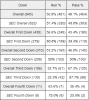
Alabama may be in the shotgun more, but Alabama's two most popular personnel groupings by far - we're talking 77.4 percent of its plays - are "11" and "21" personnel. The "11" personnel means one running back, one tight end and three wide receivers (it leads all groupings with 375 snaps) and the "21" means two running backs, one tight end.
Only "12" personnel - one running back, two tight ends - has been run more than 100 times all season long.
EXPLOSIVE PLAYS: (pass of at least 16 yards or a run of 12 yards.)
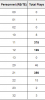
The Crimson Tide had 108 explosive plays in 13 games last season but has 141 (80 pass, 61 run) through 13 games this season.
But has Kiffin benefited in the explosive play department by just running more plays? Not really. Under former offensive coordinator Doug Nussmeier in 2013, 13.1 percent of its plays were explosive. With Kiffin this year, the team has an explosive play 14.9 percent of the time.
In raw numbers, that's 33 more explosive plays over those 13 games, meaning Alabama has enjoyed more than two more explosive plays per game than last season on average.
WHERE HAS AMARI COOPER LINED UP?
Based off our numbers, Cooper has played 750 of the team's 945 snaps - 79.4 percent of the action, by far the most among skill players. As far as his location, Cooper has lined up wide left 307 times, right 299 times, out of the left slot 74 times, the right slot 61 times, played seven snaps out of the backfield and two as the team's most inside slot receiver in an empty (five wide) look.
SIMS IMPROVING AS A PASSER
When it comes to the progression of the Alabama offense throughout the 2014 season, it's easy to point to the development of Blake Sims, its first year starting quarterback.
The numbers back up Sims' growth as a passer.

Kiffin did his best to build Sims' confidence early with short, easy throws. After the fourth game of the year - home against Florida when Sims was excellent - Kiffin has given his quarterback more leeway to make bigger throws.
Through the first four games, UF included, Sims' pass attempts traveled an average of 8.2 yards past the line of scrimmage and completions traveled an average 5.1 yards each.
Since that Florida game when Sims set the school record for total offense, those numbers have jumped. His average attempt is up to 9.3 yards and his completions have spiked to 6.7 yards apiece.
And remember all the talk in September about Sims not being able to make deep throws? As it stands today, the balance between those easy throws and deeper shots has balanced out. Sims has as many completions to receivers behind the line of scrimmage (55) as he does completions more than 10 yards downfield (54).
A SHOTGUN TEAM?
One change in the second half of the year has been Kiffin's preference to run the offense out of the shotgun or pistol formation instead of under center.
Through the first 8 games of the year, 549 plays in all, Alabama ran out of shotgun 159 times and pistol 89 times, meaning Alabama lined up under center 54.8 percent of the time.
That has changed drastically in the Crimson Tide's last five games.
Since the Tennessee game on Oct. 25, Alabama has run 255 plays out of the shotgun, 35 plays out of the pistol. That means the Crimson Tide has been under center just 32.1 percent of the time.
Narrow that to just Auburn and Missouri in the SEC Championship and Alabama has been in shotgun or pistol 110 out of its last 135 snaps.
In other words, Alabama has truly become a shotgun team.
While many assume that more shotgun means more throws, that's not the case with Kiffin given his playcalling splits. Alabama will almost never use more than three receivers on the field at once, often using tight ends or running backs lined up as receivers if it wants a four-wide or empty backfield look. And in the run game, both T.J. Yeldon and Derrick Henry are averaging more yards per carry out of the shotgun and pistol than they are when Alabama lines up under center.
So why more shotgun? There are many possible reasons. One certainly is Sims' ability as a runner; being in the shotgun presents the threat of the read option (Sims can choose to hand off to the running back or keep the ball based on the defense's look).
Another could be that Sims is more comfortable reading the field out of the shotgun vs. being under center.
It could also be that Sims can better use his ability to scramble and extend plays when he can see where the pass rush is coming from quickly.
Alabama hasn't been pinned back much this season, taking only 71 snaps inside its own 20 yard line. Compare that to its 177 snaps in opponents red zone this season (99 runs, 60 passes, 14 penalties).
Total plays by wide receivers (of 945 total)
Amari Cooper 750
DeAndrew White 522
Christion Jones 412
Chris Black 242
Cam Sims 142
ArDarius Stewart 103
Total plays by running backs (of 945 total)
T.J. Yeldon 475 (19 wide, 4 slot)
Jalston Fowler 399 (199, 131 as H back/offset TE, 27 in slot, 42 wide)
Derrick Henry 278 (2 wide)
PERSONNEL GROUPINGS
Alabama may be in the shotgun more, but Alabama's two most popular personnel groupings by far - we're talking 77.4 percent of its plays - are "11" and "21" personnel. The "11" personnel means one running back, one tight end and three wide receivers (it leads all groupings with 375 snaps) and the "21" means two running backs, one tight end.
Only "12" personnel - one running back, two tight ends - has been run more than 100 times all season long.
EXPLOSIVE PLAYS: (pass of at least 16 yards or a run of 12 yards.)
The Crimson Tide had 108 explosive plays in 13 games last season but has 141 (80 pass, 61 run) through 13 games this season.
But has Kiffin benefited in the explosive play department by just running more plays? Not really. Under former offensive coordinator Doug Nussmeier in 2013, 13.1 percent of its plays were explosive. With Kiffin this year, the team has an explosive play 14.9 percent of the time.
In raw numbers, that's 33 more explosive plays over those 13 games, meaning Alabama has enjoyed more than two more explosive plays per game than last season on average.
WHERE HAS AMARI COOPER LINED UP?
Based off our numbers, Cooper has played 750 of the team's 945 snaps - 79.4 percent of the action, by far the most among skill players. As far as his location, Cooper has lined up wide left 307 times, right 299 times, out of the left slot 74 times, the right slot 61 times, played seven snaps out of the backfield and two as the team's most inside slot receiver in an empty (five wide) look.
SIMS IMPROVING AS A PASSER
When it comes to the progression of the Alabama offense throughout the 2014 season, it's easy to point to the development of Blake Sims, its first year starting quarterback.
The numbers back up Sims' growth as a passer.
Kiffin did his best to build Sims' confidence early with short, easy throws. After the fourth game of the year - home against Florida when Sims was excellent - Kiffin has given his quarterback more leeway to make bigger throws.
Through the first four games, UF included, Sims' pass attempts traveled an average of 8.2 yards past the line of scrimmage and completions traveled an average 5.1 yards each.
Since that Florida game when Sims set the school record for total offense, those numbers have jumped. His average attempt is up to 9.3 yards and his completions have spiked to 6.7 yards apiece.
And remember all the talk in September about Sims not being able to make deep throws? As it stands today, the balance between those easy throws and deeper shots has balanced out. Sims has as many completions to receivers behind the line of scrimmage (55) as he does completions more than 10 yards downfield (54).
A SHOTGUN TEAM?
One change in the second half of the year has been Kiffin's preference to run the offense out of the shotgun or pistol formation instead of under center.
Through the first 8 games of the year, 549 plays in all, Alabama ran out of shotgun 159 times and pistol 89 times, meaning Alabama lined up under center 54.8 percent of the time.
That has changed drastically in the Crimson Tide's last five games.
Since the Tennessee game on Oct. 25, Alabama has run 255 plays out of the shotgun, 35 plays out of the pistol. That means the Crimson Tide has been under center just 32.1 percent of the time.
Narrow that to just Auburn and Missouri in the SEC Championship and Alabama has been in shotgun or pistol 110 out of its last 135 snaps.
In other words, Alabama has truly become a shotgun team.
While many assume that more shotgun means more throws, that's not the case with Kiffin given his playcalling splits. Alabama will almost never use more than three receivers on the field at once, often using tight ends or running backs lined up as receivers if it wants a four-wide or empty backfield look. And in the run game, both T.J. Yeldon and Derrick Henry are averaging more yards per carry out of the shotgun and pistol than they are when Alabama lines up under center.
So why more shotgun? There are many possible reasons. One certainly is Sims' ability as a runner; being in the shotgun presents the threat of the read option (Sims can choose to hand off to the running back or keep the ball based on the defense's look).
Another could be that Sims is more comfortable reading the field out of the shotgun vs. being under center.
It could also be that Sims can better use his ability to scramble and extend plays when he can see where the pass rush is coming from quickly.
Alabama hasn't been pinned back much this season, taking only 71 snaps inside its own 20 yard line. Compare that to its 177 snaps in opponents red zone this season (99 runs, 60 passes, 14 penalties).
Total plays by wide receivers (of 945 total)
Amari Cooper 750
DeAndrew White 522
Christion Jones 412
Chris Black 242
Cam Sims 142
ArDarius Stewart 103
Total plays by running backs (of 945 total)
T.J. Yeldon 475 (19 wide, 4 slot)
Jalston Fowler 399 (199, 131 as H back/offset TE, 27 in slot, 42 wide)
Derrick Henry 278 (2 wide)


