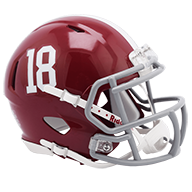

 (Image credit: Getty Images via @daylife)
A few years ago, I spent a pretty intense two days with Alabama Crimson Tide head football coach, Nick Saban. (You can read the story here.) At the time, Saban was coming off his first season at Bama. It had not gone very well: The bad vibes from his abrupt departure from the Miami Dolphins seemed to follow him to Tuscaloosa. His hugely disappointing 7-6 record in that first season was low-lighted by a home loss to Louisiana-Monroe, one he crudely compared to Pearl Harbor and 9/11.
But the seeds for future success were being planted then, even during that trying year. And we now know how the story has turned out. In six years at Alabama, Saban has gone 60-7. He has won two national championships and will play for a third on January 7 against Notre Dame.
<aside class="vestpocket" data-position="4" style="width: 175px; float: left; margin: 8px 30px 1px 0px; overflow: visible; background-color: transparent; color: rgb(0, 0, 0); position: relative; padding-bottom: 20px; border-top-width: 5px; border-top-style: solid; border-top-color: rgb(239, 239, 239); z-index: 1; border-top-left-radius: 0px; border-top-right-radius: 0px; border-bottom-right-radius: 5px; border-bottom-left-radius: 5px; font-family: Verdana, Arial, sans-serif; font-size: 13px; line-height: 13px;">
 Nick Saban Is Still The Most Powerful Coach In Sports. He's Also One Of The Best.<cite class="box_byline clearfix" style="margin: 10px 0px 0px; padding: 0px; border: 0px; outline: 0px; font-size: 10px; vertical-align: baseline; background-color: transparent; font-style: normal; line-height: 14px; font-family: Verdana; display: block; color: rgb(102, 102, 102);">
 Monte BurkeForbes Staff</cite>
</aside>Saban gets paid a lot of money. But he is worth every dime. The football team created $77 million in revenues last year, $6.5 million of which went to the university’s academic programs. But as the formerUniversity of Alabama president, Robert Witt, told me, Saban’s influence is felt off the field as well. “Having a coach of his caliber makes it easier to recruit better student and raise more money,” he said.
Football coaches are often compared to CEOs. In my mind, it’s a very fair comparison. (In fact, I wrote a book about a football coach who became a CEO, and is now a football coach again.) CEOs—any leaders, really—could learn some things from Saban. Here are a few of those lessons:
1) Surround yourself with talent. Saban is known as one of the best recruiters in college athletics (his recruiting classes are routinely ranked in the top 3 nationally). How does he do it? He appeals to the decision-makers which, most of the time, would be the parents of a young recruit. In “The Blind Side,” Michael Lewis wrote of Leigh Anne Tuohy—adoptive mother of Michael Oher—swooning as Saban entered the house. Saban told me that when he talks to a recruit and his parents, “I tell them this is a 40-year decision, not a 4-year one.” He appeals to their sense of the future. When Saban was recruiting star wide receiver, Julio Jones (who has gone on to become one the best receivers in the NFL with the Atlanta Falcons), he focused on Jones’ mother. It worked. “He came in here and talked about education. That’s what I want for my son,” Jones’ mother, Queen Marvin, told me. “Football won’t always be there.”
A side note: I have to relay one story I heard when reporting my story on Saban that’s always stuck with me. The story: Saban and Mal Moore, the Alabama athletic director, were flying to Tuscaloosa on the plane from Miami when Saban was hired to coach the Crimson Tide. As the story goes, Saban turned to Moore and asked “what do you think you’ve got with me as a coach?” Moore stammered a bit, then said: “I think we got the best coach in the country.” Saban responded: “No, you didn’t. But you got the best damn recruiter that ever lived.”
I asked both Saban and Moore about that moment. Neither man would confirm the story on the record. But when asked about it, they both smiled. Take that for whatever it means.
2) Create a “process.” Andy Staples from Sports Illustrated wrote about this back in August, about Saban’s desire to concentrate “on the steps to success rather than worrying about the result.” His players are taught to not look at the scoreboard, but focus on, say, blocking the man in front of them instead. Saban brings in speakers for his players and staff, folks like police officers and former mobsters who talk about the pitfalls of gambling. Saban told me that he was “trying to create thoughts, habits and priorities.” The “process” works a bit like Alcoholics Anonymous—one step at a time.
3) Manage the message. It may be the case that Saban goes a little overboard with this one—he personally authorizes all media interviews with players and assistant coaches. But it works. One only has to look at the NFL for counter-examples. The New York Jets offensive line coach openly questioned a decision from a person “high above” him when it came to a playing a lineman. Jets linebacker Bart Scott ripped the team’s fans. The Jets are 5-7. When this internal strife is made public, it affects a team, usually negatively. Said Saban: “You’d like to have one message with multiple voices. But it sure is easier to control with only one voice.” Part of that message is leading by example. Saban does not like distractions. While with the Dolphins, he turned down a dinner invitation with then president, George W. Bush, because he had a practice to attend.
4) Keep it simple. Football, the cliché goes, boils down to blocking and tackling. It’s a cliché because it’s true. Saban has constructed a program that does both extremely well. His defense is a base 3-4. Nothing special. But it disguises its blitzes and coverages very well. The offense? It boils down to “our’n versus your’n.” Saban has a massive yet nimble offensive line. The offensive gameplan revolves around an effective running attack, with two big and sturdy backs. The quarterback, A.J. McCarron, is a game-manager and (usually) a low-turnover guy.
5) Make wise investments in the future. The Crimson Tide will open a new $9 million weight room next year. The football stadium has undergone an $80 million expansion. The program recently extended its deal with Nike, worth $30 million. Saban has expertly managed fundraising. He brought together various different booster groups, which were once believed to be hopelessly Balkanized. He personally interviewed some of the folks he identified as key folks in the state of Alabama, the “influencers.” He manages those relationships with golf outings and invitations to his summer home.
http://www.forbes.com/sites/monteburke/2012/12/03/five-leadership-lessons-from-nick-saban/


