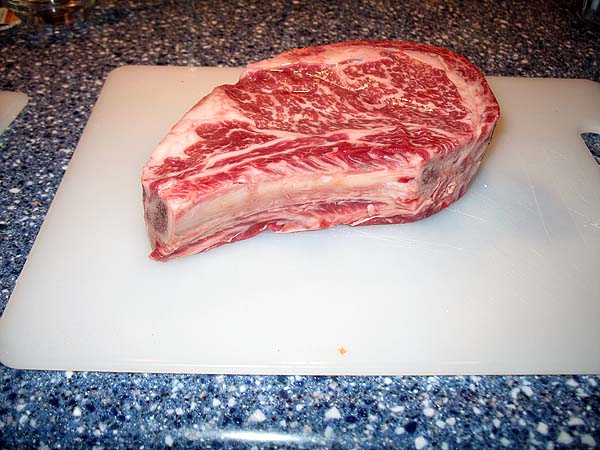
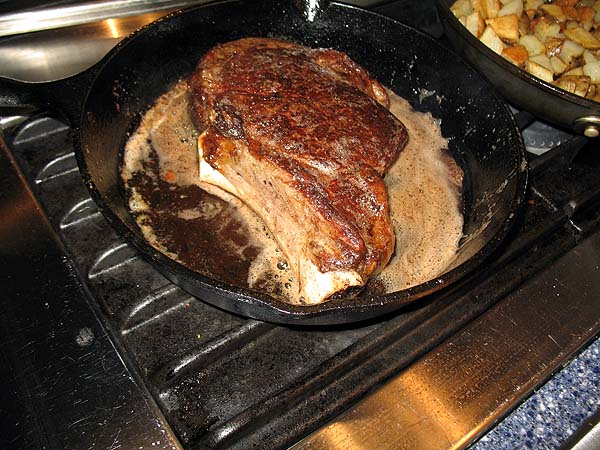
In case anyone is curious I went with this.
One of the points Ducasse makes is that when you have a piece of meat this good, it's a shame to burn it. He prefers, as do I, to get a good crust on the steak with no charring. Once you char a steak, you're substituting the carbonized flavor of burnt flesh and fat for the, in my opinion, more delicious "roasty" flavor of the Maillard reaction and the beef itself.
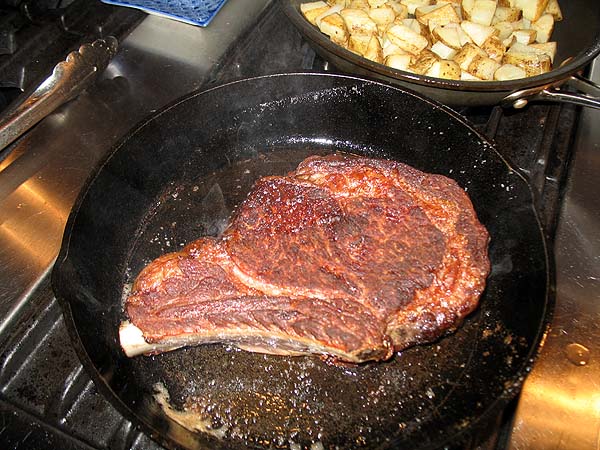
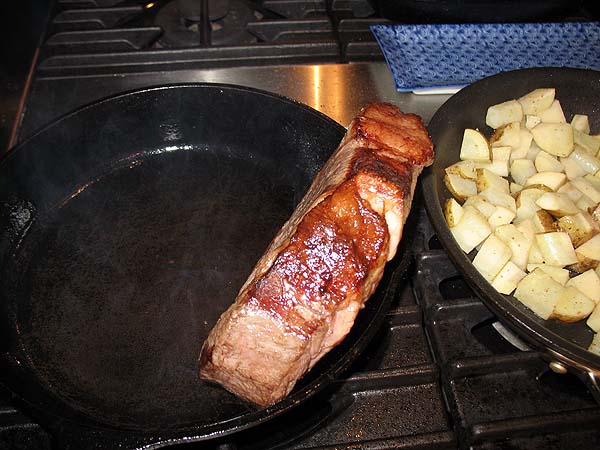
Okay, so here's the Ducasse method of making a rib steak, as interpreted by me. This is a 45-minute process, assuming you start with a steak that has been allowed to come up to room temperature or that at least has been out of the refrigerator long enough to take the chill off it. The method starts with a skillet -- in my case cast-iron but any good skillet works fine as does a pot like a rondeau -- heated to a medium heat. The steak is started on its edge. The reason for this is twofold: first, it renders the fat so you're able to cook the steak in beef fat (this echoes Ducasse's principles of flavor reinforcement, which are nearly universal in his cooking); second, it creates an appetizing appearance on the edges.
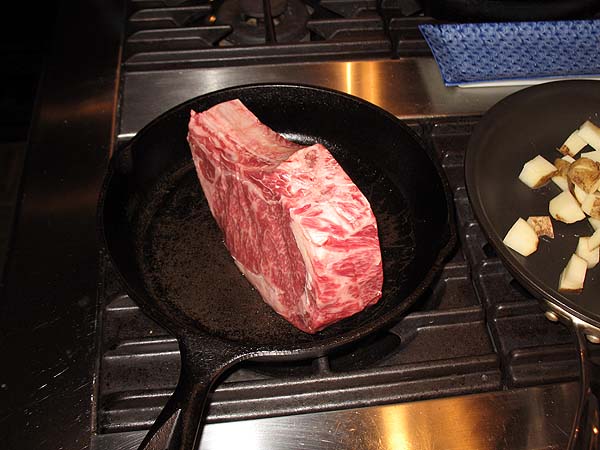
Note that there was no salt or anything added to the steak before cooking, and that the pan is dry -- no oil etc. You're just putting the steak in the skillet on its edge. If you have a big fat steak (a lot of restaurants would call this a cote de boeuf) then at first it will stand on its edge without help. But eventually you'll have to get creative with the geometry by leaning and propping the steak against the sides of the skillet in order to keep it upright while exposing as many parts of the edge as possible to the heat. If you're willing to stand there with tongs and secure the meat in various positions for 10 minutes you'll get an even more uniform and beautiful crust. Here's how this process unfolds during the first 10 or so minutes of cooking:
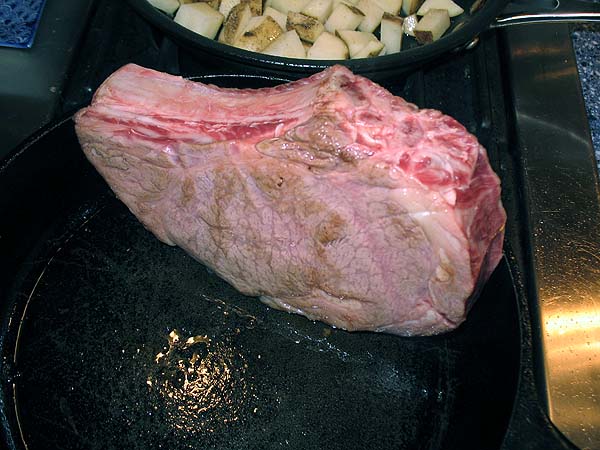
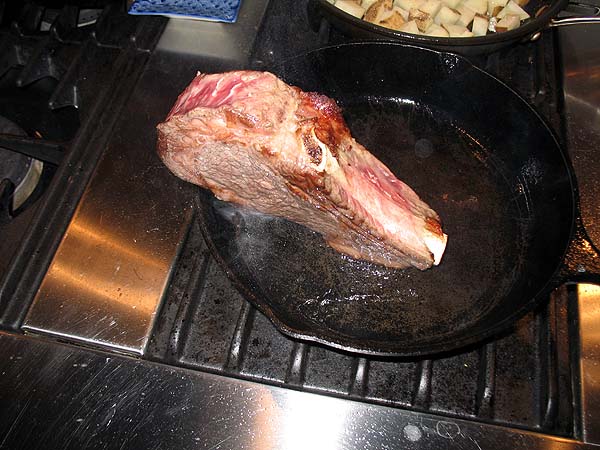
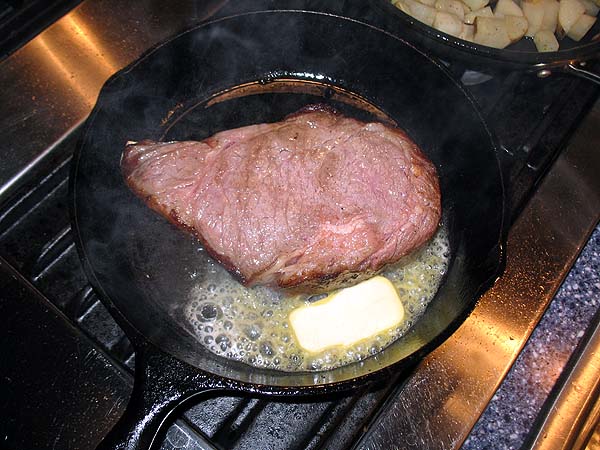
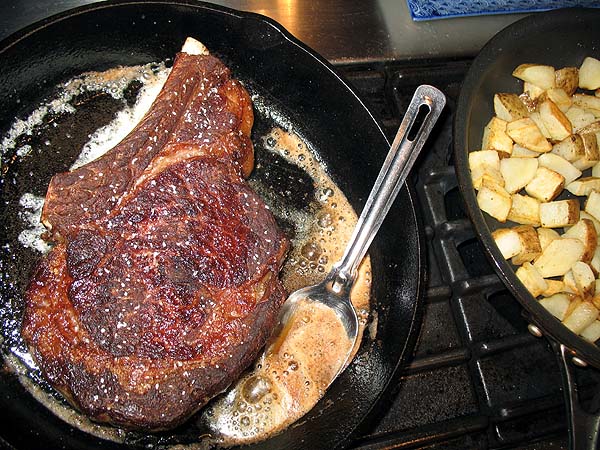
Now it's time to cook the steak on its flat faces, 10 minutes on a side. The way I prefer to do this, which is not exactly the same as how Ducasse recommends in the Times but is something I've seen done in restaurant kitchens, is to dump out enough of the beef fat so that there's a thin coating of it left in the pan, plop the steak on its flat face, and add a couple of tablespoons of butter.
A lot of people recoil at the notion of using butter as a cooking fat with steak, but I've found that butter has two excellent properties: 1- butter, more than most any other fat I know of, is a huge aid to the Maillard reaction, and 2- the combination of butter and beef fat makes a tastier cooking medium for steak than oil.
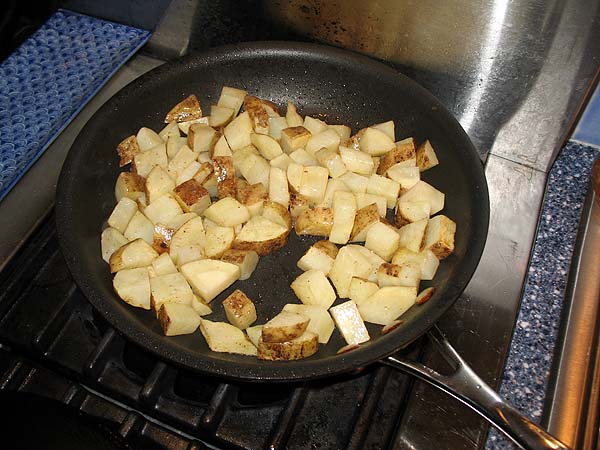
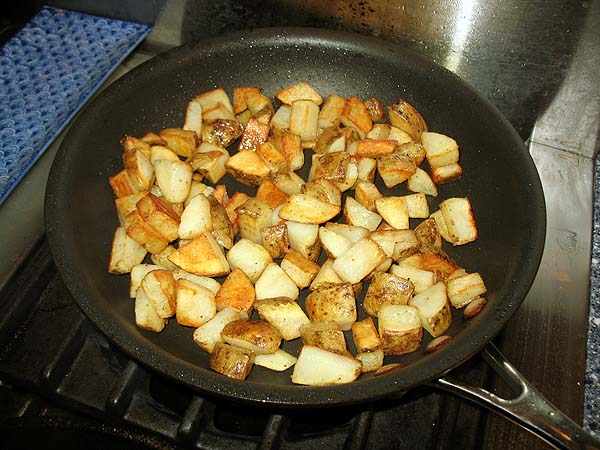
Meanwhile, I've been cooking some potatoes over medium heat in a nearby skillet. I should mention that if you're looking for a good, simple potato dish to accompany your steak then home fries are a possibility and happen to take the same 45 minutes that the steak takes to cook. There are a lot of ways to make home fries but this is a method that has worked for me and seems to make home fries that work particularly well with beef. You start with roughly chopped potatoes, salt, pepper and olive oil in a skillet over medium heat. The ratio I'm using here is two medium-size russet potatoes and half a large onion. The onion will go in later, though. If you start the onions and potatoes together, the onions will burn.
Now, after about 10 minutes the butter has browned to the point where, if we don't do something, it's going to start imparting burnt flavors to the steak.
In the first stages of browning, butter has desirable flavors. But eventually, even with medium heat, it breaks down. So it's time to renew the butter by dumping the cooking fat and adding another couple of tablespoons. I believe Ducasse recommends only adding the butter towards the end of cooking, but I think the steak comes out a little better when you use butter all the way through to coax a little more of the Maillard reaction from the steak.
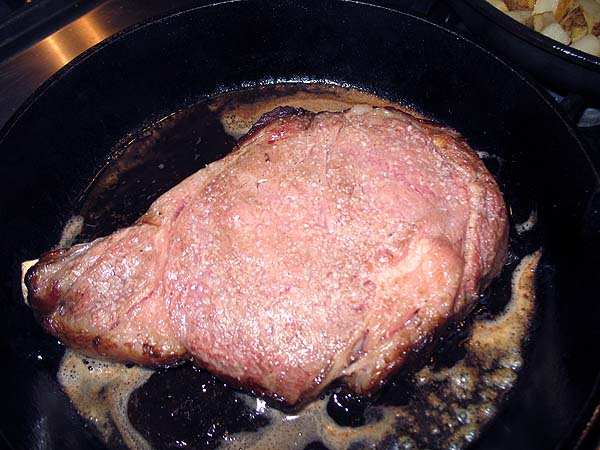
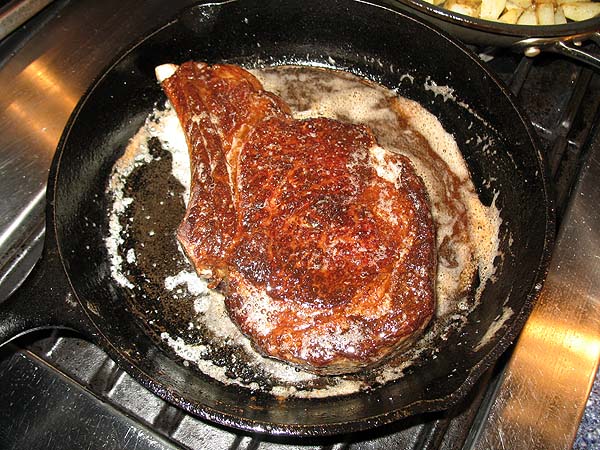
So we are at the 20-minute mark. We've browned our edges and cooked one side of the steak in a mixture of beef fat and butter for 10 minutes over medium heat. We've dumped the fat and flipped the steak. Witness the crust:
Once I saw that crust -- beautifully browned but not at all charred -- for the first time I became a believer in the Ducasse method. But it gets better. Now you add some more butter, let it melt, and spoon it over the crust (aka basting). This is also when I sprinkle the steak liberally with coarse salt. I know this is much, much later in the cooking process than anybody will tell you to salt a steak, but I find that it yields good results.
Here we are about to baste.
And the crust gets even better after basting.
Continue to cook for about another 10 minutes, basting occasionally if you like (though you've derived most of the basting benefit from the first baste).
Meanwhile, our potatoes are coming along, with some browning happening here and there. It's still too soon to add the onions, though.
Now we are almost at the 30-minute mark, so the last thing to do is flip the steak and baste (and salt) the other side.
Now the steak will have to rest for 15 minutes in a warm place (the Ducasse rule of thumb is to rest meat for half as long as you cooked it) before being carved. I use a warm plate near the stove. A 150-degree oven is also an option, and if you use on oven you can rest even longer without worrying about the steak getting too cool to be appetizing.