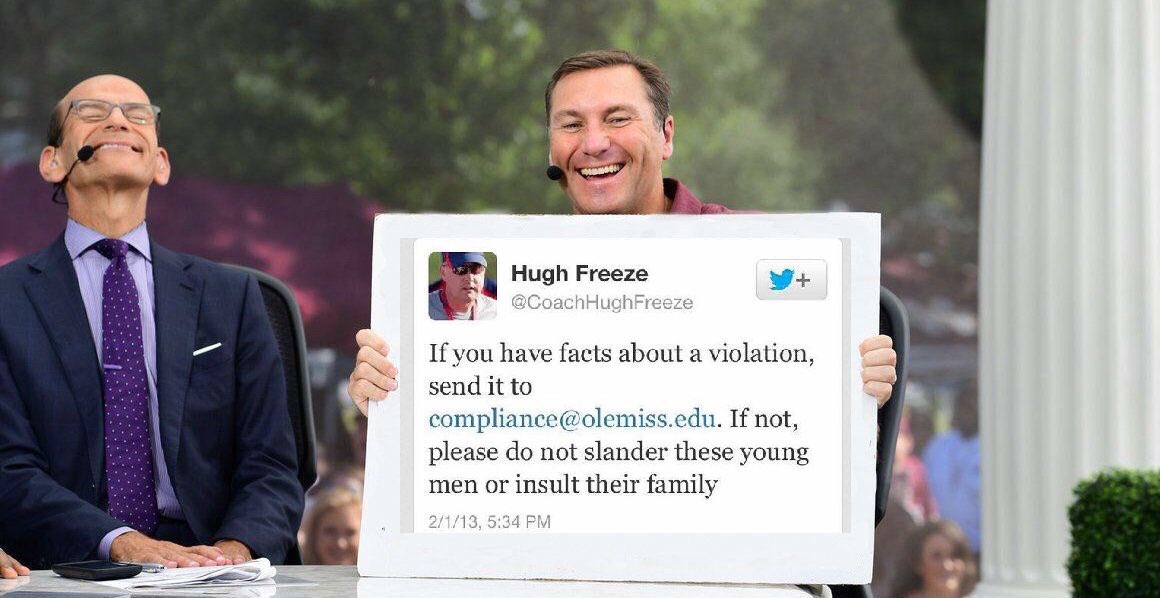
Here it is:
‘Burner Phone’ Accusation Marks New Chapter in Ole Miss Scandal
The school reported to the NCAA a lawyer’s allegation that its football coaches used prepaid phones to conceal contacts with recruits
Former Ole Miss football coach Hugh Freeze during a game last season. PHOTO: JAMES PUGH/ASSOCIATED PRESS
By
Andrew Beaton
Sept. 19, 2017 10:42 a.m. ET
46 COMMENTS
In August, University of Mississippi athletic director Ross Bjork assembled the football team’s coaching staff in a meeting room. He handed out a form that asked the coaches to disclose whether they had used personal phones, including “prepaid phones, pay as you go, burner, etc.” for recruiting or any other work-related purpose.
If the coaches had done so, the form said, those phones could be subject to records requests or “required to be furnished upon request of the University or NCAA to ensure compliance with University, SEC and NCAA rules.”
The unusual demand was in response to an accusation that coaches at Ole Miss—already under NCAA investigation for recruiting violations—had improperly used burner phones to contact football recruits, according to records reviewed by The Wall Street Journal.
The accusation came from a lawyer for Houston Nutt, a former Ole Miss coach who is suing the school over an alleged smear campaign by the school surrounding its ongoing NCAA investigation. Over the summer, Nutt’s lawyer, Thomas Mars, had previously contacted the university with information showing that Nutt’s successor, Hugh Freeze,
had made a call from a university-provided phone to a number associated with an escort service. Later,
Freeze was ousted as a result.
RELATED
Then on July 25, five days after Freeze’s dismissal, Mars wrote a text message to the school’s lead lawyer alleging that Freeze and at least three other staff members used burner phones “on a regular basis” to hide communications with recruits that would violate NCAA rules. A later letter from Mars said he had a sworn affidavit testifying to Freeze’s use of burner phones, in violation of NCAA rules. The use of unreported burner phones would make it more difficult to monitor recruiting practices, which are strictly regulated by the NCAA.
Mars’s letter prompted Ole Miss to self-report the information to the NCAA and distribute the phone declaration form to the football staff. Of the 29 people who filled it out, the school says, none reported using a burner, prepaid or pay-as-you-go phone during their time at Ole Miss.
“Our coaching staff understands the scrutiny that we’ve been under,” Bjork said in an interview. “We wanted to be proactive and organized.” He adds that the school and its internal monitoring systems haven’t uncovered any evidence to support the claims about burner-phone usage. ”There’s no indication of any other violations like that,” he said.
For the school, the accusation is the latest in a series of alleged improprieties in a football program that has been turned upside down in a couple short years.
It also is an extension of an uncomfortable public scrape in which one former Ole Miss coach, Nutt, is using an aggressive lawyer—Mars, a former
Wal-Mart Stores Inc. general counsel—who has uncovered alleged rules violations by his successor, Freeze.
The vehicle for Nutt’s pursuit of Freeze and Ole Miss is a civil lawsuit in which Nutt alleges that Freeze, and possibly other Ole Miss officials, made calls to sports journalists as part of a “smear campaign” against Nutt and spread misinformation that Nutt was to blame for the school’s NCAA issues.
Throughout the NCAA investigation, the university stood by Freeze, the coach who brought top-ranked recruiting classes to Oxford, Miss., beat Alabama in back-to-back seasons and won the Sugar Bowl just two years ago. An attorney for Freeze could not be reached for comment.
Former Ole Miss football coach Hugh Freeze speaks during an alumni event in April as chancellor Jeff Vitter, left, and athletic director Ross Bjork, right, sit nearby. PHOTO: LAUREN WOOD/ASSOCIATED PRESS
The school has denied the allegations in Nutt’s lawsuit. The case was dismissed from federal court on jurisdictional grounds, and Nutt’s team plans to file a new case in state court soon.
The first strike came this summer, when Ole Miss jettisoned Freeze after phone records brought to the attention of Mars showed that Freeze made a call, from his university-issued phone, to a number connected with escort services. The school initially characterized the call as a “misdial.” Days later, the university parted ways with Freeze after discovering other similar calls, made over the course of several years, which coincided with recruiting trips, the Journal reported in August.
The new accusations began when Mars notified the school in July that he had evidence about alleged misuse of burner phones in recruiting. He alleged that coaches purchased phones with cash, sometimes at out of state locations or using fictitious names, that they used to conceal “communications with prospects that were prohibited by the NCAA’s rules.”
In some instances, Mars wrote, third parties bought the burners and then gave them to coaches. It also alleges the coaches instructed recruits not to put their names with these numbers in the contacts sections of their phone.
Mars offered to settle the Nutt litigation before making public-records requests to collect additional phone records of Freeze and three other coaches. “I’m running out of patience, so don’t expect me to sit on this information for more than a few hours,” he wrote.
Ole Miss did not accept the settlement proposal, which among other things involved an apology to Nutt. In an August 9 letter to the school’s outside counsel, Mars wrote: “While my silence isn’t for sale, our offer was intentionally framed to spare Ole Miss from any more public embarrassment. As I assume you know, this isn’t the first time I’ve attempted to give the university an opportunity to deal with its dirty laundry before it becomes a public spectacle.”
The next day, Enrique Gimenez, an outside counsel representing Ole Miss in its NCAA investigation, wrote a letter to Jon Duncan, the NCAA’s vice president of enforcement, informing him of the accusations. The letter says the university asked Nutt’s legal team to share their information suggesting violations but was denied. Mars says the two sides could not agree on terms for disclosing the affidavit to the university.
In a civil lawsuit, former Ole Miss coach Houston Nutt alleges that Hugh Freeze, and possibly other Ole Miss officials, made calls to sports journalists as part of a ‘smear campaign’ against Nutt and spread misinformation that Nutt was to blame for the school’s NCAA issues. PHOTO: MARK HUMPHREY/ASSOCIATED PRESS
“If the staff is able to secure any credible information on which it can move forward, we stand willing to continue our cooperative efforts to develop a full and fair factual record,” Gimenez’s letter to Duncan says.
Per the NCAA’s policy on ongoing investigations, Duncan declined to comment. The NCAA’s alleged violations include charges of lack of institutional control, cash payments to prospective players, and other recruiting violations. The school has disputed some, but not all, of the NCAA’s charges.
This potential burner phone issue would only add to the questions of impropriety at Ole Miss. Ole Miss is under a self-imposed postseason ban as a result of that probe. The school met with the NCAA’s Committee on Infractions about those violations last week. Burner phones were not mentioned in the NCAA’s notice of allegations, and the college sports governing body declined comment on whether they were discussed at last week’s infractions meeting.
Write to Andrew Beaton at
andrew.beaton@wsj.com


 opcorn2: