
The Secrets of College Football’s Best Teams
The Secrets of College Football’s Best Teams
We requested past game plans from Alabama, Georgia and other prominent teams under public records laws. They all refused.
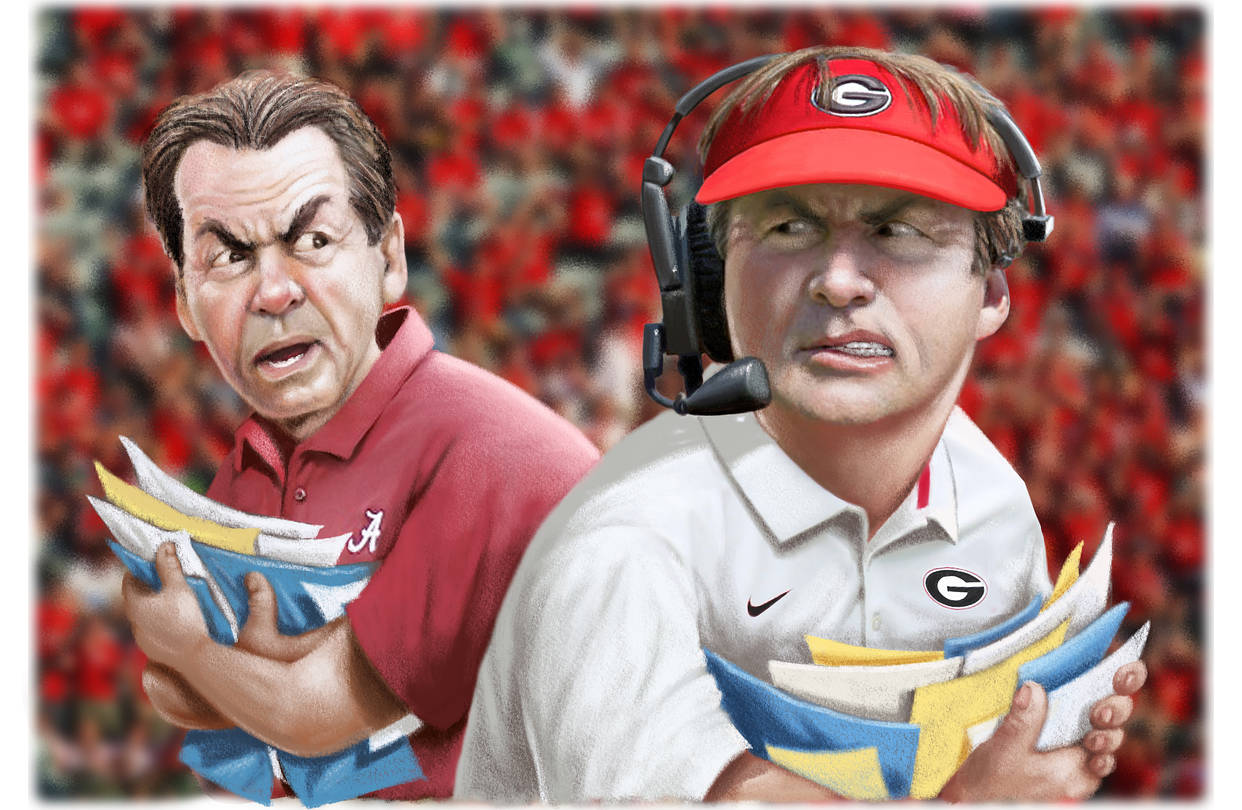
PHOTO: SCOTT POLLACK
By
Andrew Beaton and
Ben Cohen
Updated Jan. 8, 2018 10:09 a.m. ET
11 COMMENTS
They are classified as trade secrets. They are protected by intellectual property laws. And they are valuable enough that public institutions take pains to shield them.
The documents they don’t want you to see: football game plans.
If a playbook is a team’s arsenal, then a game plan is the battle strategy. Which is why The Wall Street Journal requested game plans from specific past games of more than a dozen highly ranked teams—including Alabama and Georgia, the schools in college football’s national championship on Monday night—using open-record laws that govern public universities.
The requests were denied by every school. Most cited state laws protecting trade secrets. But some universities offered more detailed rejections that explained how much they prize the most revealing documents in college football.
Louisiana State University said disclosing the plans would violate the coaches’ privacy. Louisville said releasing them would “compromise a significant governmental interest.” Wisconsin said bluntly that it would hurt the Badgers on the field.
“If our plays can be accessed by others,” Wisconsin’s response said, “they will lose effectiveness and the success of the program will suffer.”
The schools go to extremes to keep this information private, even though it’s funded by millions of taxpayer dollars, going so far as to enclose practices with black screens and not save anything on shared computer networks.
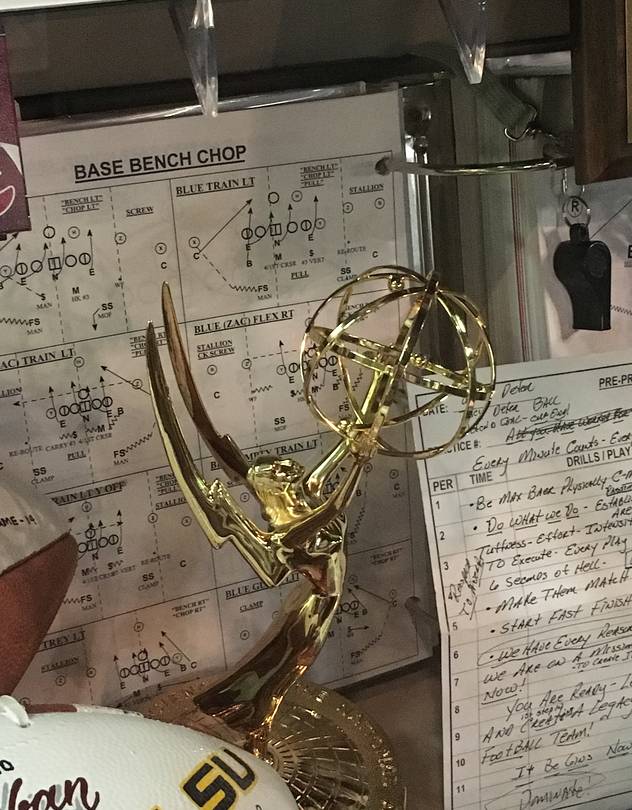
Alabama's 2009 game plan vs FIU on display at the Alabama Sports Hall of Fame. PHOTO:ALABAMA SPORTS HALL OF FAME
But it isn’t unusual for coaches to share intelligence with each other. They compare X’s and O’s notes at clinics. They visit each other’s camps in the off-season. They even share their favorite plays and formations in books published by coaches’ associations and shoe companies with taglines like “The More We Tell, The More We Sell”—which only illuminates the conflict at the heart of college football.
“There’s a culture of sharing and openness,” said Chris Brown, the founder of the website Smart Football, “and then there’s a culture of paranoia.”
The culture of paranoia lives even if law scholars and transparency advocates doubt the legal arguments by the schools would stand up to legal scrutiny. Frank LoMonte, the director of Florida’s Brechner Center for Freedom of Information, dismissed the relevance of privacy laws that some universities invoked and questioned the legitimacy of applying statutes meant for protecting trade secrets to football playbooks.
“It’s not clear to me that any of the traditional exemptions really fit with these records,” he said. “Some of the exemptions cited by the universities are very clearly off the mark.”
Schools also have their own way of getting another school’s playbook: They can hire their coaches. Georgia wanted former Alabama defensive coordinator Kirby Smart, for example, in part because he knew Nick Saban’s playbook as well as anyone on the planet. “Why is it that Georgia can buy this information but the public can’t get it?” said Paul Haagen, a Duke law professor and co-director of the Center for Sports Law and Policy.
To understand why anyone—rival coaches, curious fans, nosy reporters—might want to get their hands on a game plan, it’s important to understand what’s actually in a game plan.
Coaches say they contain every piece of information their teams need to know before they step on the field. There are diagrams, bullet points, statistics, the odd emoji and many, many exclamation points. They’re published in three-ring binders and on iPads, and they take so long to compile that assistants began weeks in advance.
It starts with the basics: Plays they know they can run any time in any situation. Then it gets more granular. There are calls for first downs, third-and-short, third-and-long, red-zone, goal-line and every situation imaginable. Some of this stays the same every week. Other parts change based on specific opponents. And then there is a full scouting report about the other team.
Despite the secrecy, the Journal was able to review Saban’s defensive game plan for his most recent game: Alabama’s win over Clemson in the College Football Playoff semifinal last week.
The 56-page document is a window into the immense amount of preparation that goes into one college-football game. The first half breaks down Clemson’s offensive personnel, formations and plays; the second half is for diagrams of the defensive plays Alabama planned to use in the semifinal. There are also three pages at the end with handwritten notes that match Saban’s penmanship. The game plan was the result of analyzing six Clemson games: five against the best teams the Tigers played this year, plus last year’s national championship against Alabama.
The most important takeaways are written like this: “WHEN THEY WANT TO GO FAST,” the game plan says in big, underlined red font, “THEY HAVE BEEN ABLE TO SNAP THE BALL IN UNDER 15 SECONDS.”
Then there was even a page with emojis. Two enormous nose emojis, to be precise. In football, the player who lines up behind or between the guard and tackle is known as the “sniffer back,” and Alabama’s coaches wanted their defense to watch Clemson’s sniffer back carefully. They believed his actions could tip the type of play the Tigers were running. So they circled this player and wrote “TRACK THE SNIFFER!!!” between the nose emojis.

The Crimson Tide’s defensive game plan in the Sugar Bowl was the result of analyzing six Clemson games: five against the best teams the Tigers played this year, plus last year’s national championship against Alabama. PHOTO:JAMIE SQUIRE/GETTY IMAGES
Alabama defensive line coach Karl Dunbar downplays the secrecy of anyone’s playbook. They are so technical, he said, that only someone with inside knowledge could decipher what they mean. “It’s almost like picking up a Japanese book and trying to read it,” Dunbar said. “There’s some good information in there, but I don’t understand it.”
Alabama nonetheless denied the Journal’s request for game plans from previous years. “The type of documents you requested are not public records under Alabama law,” the university said. A spokeswoman for the school’s public records office did not respond to requests for clarification.
In the Southeastern Conference, LoMonte said there is a “race to the bottom to see who can be the most secretive and least cooperative.” Florida’s athletic department, for example, has the power to deny requests because its athletic department technically falls under a “direct-support organization” of the public university that is exempt from open-record laws. Florida responded to the Journal’s request for its game plans against Florida State and Alabama last season with one irrelevant sheet of paper: an official travel itinerary. “We have provided every nonconfidential record that pertains to your request,” a university spokesman said.
Kirby Smart has imported Alabama’s secretive approach at Georgia. In February 2016, not long after he was hired, Smart toured the state capitol, met key lawmakers and dined with the governor. He even received a special commendation.
Less than a month after his visit came the introduction of Senate Bill 323 to amend an obscure clause in the state code governing documents related to economic development projects. It was immediately known as “Kirby’s Law” because it came up in Smart’s conversation with the lawmakers.
The change extended the deadline for responses to certain records requests relating to college sports. It gave athletic programs 90 days to respond—an increase of 87 days. Georgia’s lieutenant governor Casey Cagle—who, like Smart, was a defensive back for the Bulldogs—was one of the many politicians who chatted with Smart that day. Even before it was passed, and long before it was enacted, Cagle made it clear the bill called Kirby’s Law had his full support.
“I hope it brings us a national championship,” he said.
Corrections & Amplifications
A photo caption of the Clemson/Alabama game in an earlier version of the story incorrectly stated that it was at the Rose Bowl. Clemson and Alabama played in the Sugar Bowl on Jan. 1.
Write to Andrew Beaton at andrew.beaton@wsj.com and Ben Cohen at ben.cohen@wsj.com
The Secrets of College Football’s Best Teams
We requested past game plans from Alabama, Georgia and other prominent teams under public records laws. They all refused.
PHOTO: SCOTT POLLACK
By
Andrew Beaton and
Ben Cohen
Updated Jan. 8, 2018 10:09 a.m. ET
11 COMMENTS
They are classified as trade secrets. They are protected by intellectual property laws. And they are valuable enough that public institutions take pains to shield them.
The documents they don’t want you to see: football game plans.
If a playbook is a team’s arsenal, then a game plan is the battle strategy. Which is why The Wall Street Journal requested game plans from specific past games of more than a dozen highly ranked teams—including Alabama and Georgia, the schools in college football’s national championship on Monday night—using open-record laws that govern public universities.
The requests were denied by every school. Most cited state laws protecting trade secrets. But some universities offered more detailed rejections that explained how much they prize the most revealing documents in college football.
Louisiana State University said disclosing the plans would violate the coaches’ privacy. Louisville said releasing them would “compromise a significant governmental interest.” Wisconsin said bluntly that it would hurt the Badgers on the field.
“If our plays can be accessed by others,” Wisconsin’s response said, “they will lose effectiveness and the success of the program will suffer.”
The schools go to extremes to keep this information private, even though it’s funded by millions of taxpayer dollars, going so far as to enclose practices with black screens and not save anything on shared computer networks.
Alabama's 2009 game plan vs FIU on display at the Alabama Sports Hall of Fame. PHOTO:ALABAMA SPORTS HALL OF FAME
But it isn’t unusual for coaches to share intelligence with each other. They compare X’s and O’s notes at clinics. They visit each other’s camps in the off-season. They even share their favorite plays and formations in books published by coaches’ associations and shoe companies with taglines like “The More We Tell, The More We Sell”—which only illuminates the conflict at the heart of college football.
“There’s a culture of sharing and openness,” said Chris Brown, the founder of the website Smart Football, “and then there’s a culture of paranoia.”
The culture of paranoia lives even if law scholars and transparency advocates doubt the legal arguments by the schools would stand up to legal scrutiny. Frank LoMonte, the director of Florida’s Brechner Center for Freedom of Information, dismissed the relevance of privacy laws that some universities invoked and questioned the legitimacy of applying statutes meant for protecting trade secrets to football playbooks.
“It’s not clear to me that any of the traditional exemptions really fit with these records,” he said. “Some of the exemptions cited by the universities are very clearly off the mark.”
Schools also have their own way of getting another school’s playbook: They can hire their coaches. Georgia wanted former Alabama defensive coordinator Kirby Smart, for example, in part because he knew Nick Saban’s playbook as well as anyone on the planet. “Why is it that Georgia can buy this information but the public can’t get it?” said Paul Haagen, a Duke law professor and co-director of the Center for Sports Law and Policy.
To understand why anyone—rival coaches, curious fans, nosy reporters—might want to get their hands on a game plan, it’s important to understand what’s actually in a game plan.
Coaches say they contain every piece of information their teams need to know before they step on the field. There are diagrams, bullet points, statistics, the odd emoji and many, many exclamation points. They’re published in three-ring binders and on iPads, and they take so long to compile that assistants began weeks in advance.
It starts with the basics: Plays they know they can run any time in any situation. Then it gets more granular. There are calls for first downs, third-and-short, third-and-long, red-zone, goal-line and every situation imaginable. Some of this stays the same every week. Other parts change based on specific opponents. And then there is a full scouting report about the other team.
Despite the secrecy, the Journal was able to review Saban’s defensive game plan for his most recent game: Alabama’s win over Clemson in the College Football Playoff semifinal last week.
The 56-page document is a window into the immense amount of preparation that goes into one college-football game. The first half breaks down Clemson’s offensive personnel, formations and plays; the second half is for diagrams of the defensive plays Alabama planned to use in the semifinal. There are also three pages at the end with handwritten notes that match Saban’s penmanship. The game plan was the result of analyzing six Clemson games: five against the best teams the Tigers played this year, plus last year’s national championship against Alabama.
The most important takeaways are written like this: “WHEN THEY WANT TO GO FAST,” the game plan says in big, underlined red font, “THEY HAVE BEEN ABLE TO SNAP THE BALL IN UNDER 15 SECONDS.”
Then there was even a page with emojis. Two enormous nose emojis, to be precise. In football, the player who lines up behind or between the guard and tackle is known as the “sniffer back,” and Alabama’s coaches wanted their defense to watch Clemson’s sniffer back carefully. They believed his actions could tip the type of play the Tigers were running. So they circled this player and wrote “TRACK THE SNIFFER!!!” between the nose emojis.
The Crimson Tide’s defensive game plan in the Sugar Bowl was the result of analyzing six Clemson games: five against the best teams the Tigers played this year, plus last year’s national championship against Alabama. PHOTO:JAMIE SQUIRE/GETTY IMAGES
Alabama defensive line coach Karl Dunbar downplays the secrecy of anyone’s playbook. They are so technical, he said, that only someone with inside knowledge could decipher what they mean. “It’s almost like picking up a Japanese book and trying to read it,” Dunbar said. “There’s some good information in there, but I don’t understand it.”
Alabama nonetheless denied the Journal’s request for game plans from previous years. “The type of documents you requested are not public records under Alabama law,” the university said. A spokeswoman for the school’s public records office did not respond to requests for clarification.
In the Southeastern Conference, LoMonte said there is a “race to the bottom to see who can be the most secretive and least cooperative.” Florida’s athletic department, for example, has the power to deny requests because its athletic department technically falls under a “direct-support organization” of the public university that is exempt from open-record laws. Florida responded to the Journal’s request for its game plans against Florida State and Alabama last season with one irrelevant sheet of paper: an official travel itinerary. “We have provided every nonconfidential record that pertains to your request,” a university spokesman said.
Kirby Smart has imported Alabama’s secretive approach at Georgia. In February 2016, not long after he was hired, Smart toured the state capitol, met key lawmakers and dined with the governor. He even received a special commendation.
Less than a month after his visit came the introduction of Senate Bill 323 to amend an obscure clause in the state code governing documents related to economic development projects. It was immediately known as “Kirby’s Law” because it came up in Smart’s conversation with the lawmakers.
The change extended the deadline for responses to certain records requests relating to college sports. It gave athletic programs 90 days to respond—an increase of 87 days. Georgia’s lieutenant governor Casey Cagle—who, like Smart, was a defensive back for the Bulldogs—was one of the many politicians who chatted with Smart that day. Even before it was passed, and long before it was enacted, Cagle made it clear the bill called Kirby’s Law had his full support.
“I hope it brings us a national championship,” he said.
Corrections & Amplifications
A photo caption of the Clemson/Alabama game in an earlier version of the story incorrectly stated that it was at the Rose Bowl. Clemson and Alabama played in the Sugar Bowl on Jan. 1.
Write to Andrew Beaton at andrew.beaton@wsj.com and Ben Cohen at ben.cohen@wsj.com
Last edited by a moderator:


