Does Georgia have playmakers or is this just another "blue-chip service academy" offense?
Georgia might be the most trustworthy team in the country. Even if the effects of the transfer portal era have siphoned away some of its depth and left it less experienced overall, we know it is going to brawl its way to results. It has reached five straight SEC championship games, winning three, and it has won the past two despite defensive inexperience and a lack of big plays on offense.
There has still been a bit of a drop-off, however. After going 42-2 from 2021 to 23, it
merely went 23-5 in 2024-25, finishing sixth in SP+ both years. That isn't exactly an embarrassment, but in both seasons the Dawgs suffered from a lack of big plays and easy points.
The company they kept on this efficiency/explosiveness chart tells quite a story.
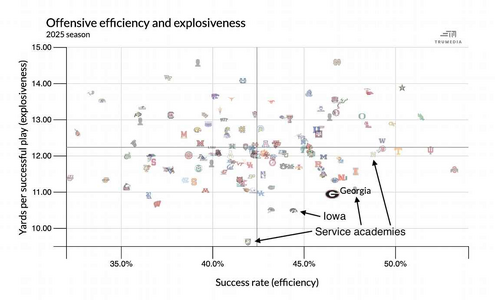
Last year's run game was solid and efficient, and in wideout
Zachariah Branch,
Gunner Stockton had an excellent, quick-pitch efficiency option. But Stockton averaged just 10.8 yards per completion, and while leading rusher
Nate Frazier almost never lost yardage, he didn't break long gainers either. Statistically, this was basically a service academy offense -- or a blue-chip
Iowa -- with its countless ways of gaining five yards but almost no chunk plays.
With Frazier,
Chauncey Bowens,
Kentucky transfer
Dante Dowdell and three starters returning up front, the Dawgs should be able to grind away between the tackles again. The defensive front seven could be UGA's best in years, too. But of the seven players with more than 15 receptions, six are gone, including Branch. Stockton will still have receiver
London Humphreys and tight end
Lawson Luckie, and
Georgia Tech transfer
Isiah Canion averaged 14.6 yards per catch last year (though with fewer than three catches per game). If the 6-foot-4 Canion becomes a go-to performer, he could be exactly what the Dawgs missed in 2025. But he's one of the most important transfers in the SEC because if he's not a big-time acquisition, the passing game might be even less threatening in 2026.