
I know it isn't true. But, it's a great tool if ever needed.
I learned how to play chess in an unusual way. A friend of mine, David, introduced me to the game. In the first week I'd bought a cheap chess set and checked out a book of past chess games from the library in Memphis. I knew the pieces and how they moved; the book introduced me to strategies.
How do you teach someone how the pieces move? Hearing this explained in this manner shocked me in its simplicity.
A Knight is represented by a horse. A horse has two ears and a snout. There's two squares one way, one perpendicular.
A Rook has merlons (notches) which indicated rank and file for movement. Four directions: left or right along with up and down the file.
A Queen often has eight indentations on her crown: she moves in all eight directions.
Now, look at the bishop. The slit? Diagonal movement.
If you play...it's a bit crazy when you think about it, right?
I learned how to play chess in an unusual way. A friend of mine, David, introduced me to the game. In the first week I'd bought a cheap chess set and checked out a book of past chess games from the library in Memphis. I knew the pieces and how they moved; the book introduced me to strategies.
How do you teach someone how the pieces move? Hearing this explained in this manner shocked me in its simplicity.
A Knight is represented by a horse. A horse has two ears and a snout. There's two squares one way, one perpendicular.
A Rook has merlons (notches) which indicated rank and file for movement. Four directions: left or right along with up and down the file.
A Queen often has eight indentations on her crown: she moves in all eight directions.
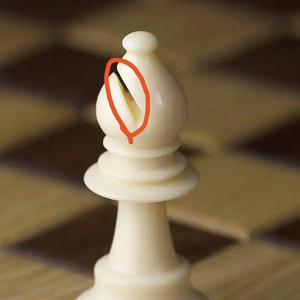
Now, look at the bishop. The slit? Diagonal movement.
If you play...it's a bit crazy when you think about it, right?


