
We've hit college football's midway mark, but what do we really know? At this point last season, Oregon and Kansas State looked like legitimate BCS championship contenders, Geno Smith looked like a stronger Heisman candidate than Johnny Manziel, and Oregon State looked like a Rose Bowl Cinderella. College football's short season makes every week a thrill, but it also generates a small sample size that hamstrings our ability to properly evaluate each team.
In order to gain clarity, we need to look beyond pervasive but potentially misleading statistics such as points per game. Instead, we need to examine yards per play. This stat isolates the relative strength of each unit, capturing an offense's ability to move the ball and a defense's skill in preventing such drives. Yards per play can also be adjusted for strength of schedule, a key factor in evaluating teams.
A team's average points per game still matters, but it's become college football's ERA: an outdated metric that doesn't always provide the flexibility we need. FIP, which accounts for variables a pitcher can actually control, has emerged as a preferred metric in baseball. Yards per play is college football's peripheral-stat equivalent.
So what does examining yards per play actually tell us? Well, quite a bit. Using that metric, here are seven predictions for the season's remaining weeks.
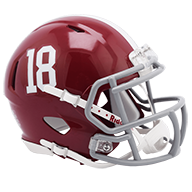
Alabama Will Not Win the National Championship
The two-time defending BCS champions are 6-0 and ranked first in the AP poll. Nick Saban remains arguably the best head coach alive today. So, what's the problem?
Yards per play suggests that Alabama lacks a national champion's credentials.
The Alabama defense has allowed 4.8 yards per play this season compared to the 5.54 FBS average. While most teams would celebrate ranking 23rd in this metric, it's a letdown for Saban's squad. Last season, Alabama allowed 4.2 yards per play, second best in the nation.
This year, the Tide surrendered 8.85 yards per play to Johnny Manziel and Texas A&M. That's an extreme example, but it's also emblematic of Alabama's defensive regression.
The offense has also regressed from last season's stellar production. AJ McCarron and crew have gained 6.9 yards per play, 10th best in the nation. However, four of Alabama's six opponents to date (Texas A&M, Kentucky, Colorado State, and Georgia State) field defenses ranked worse than 100th in yards per play, adjusted or unadjusted. After accounting for schedule, Alabama's offensive ranking dips from 10th to 26th.
Saban summed up his team's offensive ills in his halftime interview during the Mississippi game: "We're not executing. … Most people say it's the plays you call. Well, really, it's the execution of the plays that really matters." Trust Saban to deliver the key to the college football pecking order with one pithy sentence.
Alabama must still play LSU, which emerged defensively against Florida in Week 7, and the SEC East champion should the Tide advance to Atlanta. It's reasonable to think that Alabama is a better team than yards per play suggests, but the metrics are still telling: With a combined offensive and defensive ranking of 19th, Alabama is not currently playing well enough to three-peat.

Clemson won't win the NC, the impact of the loss of Franklin for Mizzou, Louisville crashing the BCS party, and more here...
In order to gain clarity, we need to look beyond pervasive but potentially misleading statistics such as points per game. Instead, we need to examine yards per play. This stat isolates the relative strength of each unit, capturing an offense's ability to move the ball and a defense's skill in preventing such drives. Yards per play can also be adjusted for strength of schedule, a key factor in evaluating teams.
A team's average points per game still matters, but it's become college football's ERA: an outdated metric that doesn't always provide the flexibility we need. FIP, which accounts for variables a pitcher can actually control, has emerged as a preferred metric in baseball. Yards per play is college football's peripheral-stat equivalent.
So what does examining yards per play actually tell us? Well, quite a bit. Using that metric, here are seven predictions for the season's remaining weeks.
Alabama Will Not Win the National Championship
The two-time defending BCS champions are 6-0 and ranked first in the AP poll. Nick Saban remains arguably the best head coach alive today. So, what's the problem?
Yards per play suggests that Alabama lacks a national champion's credentials.
The Alabama defense has allowed 4.8 yards per play this season compared to the 5.54 FBS average. While most teams would celebrate ranking 23rd in this metric, it's a letdown for Saban's squad. Last season, Alabama allowed 4.2 yards per play, second best in the nation.
This year, the Tide surrendered 8.85 yards per play to Johnny Manziel and Texas A&M. That's an extreme example, but it's also emblematic of Alabama's defensive regression.
The offense has also regressed from last season's stellar production. AJ McCarron and crew have gained 6.9 yards per play, 10th best in the nation. However, four of Alabama's six opponents to date (Texas A&M, Kentucky, Colorado State, and Georgia State) field defenses ranked worse than 100th in yards per play, adjusted or unadjusted. After accounting for schedule, Alabama's offensive ranking dips from 10th to 26th.
Saban summed up his team's offensive ills in his halftime interview during the Mississippi game: "We're not executing. … Most people say it's the plays you call. Well, really, it's the execution of the plays that really matters." Trust Saban to deliver the key to the college football pecking order with one pithy sentence.
Alabama must still play LSU, which emerged defensively against Florida in Week 7, and the SEC East champion should the Tide advance to Atlanta. It's reasonable to think that Alabama is a better team than yards per play suggests, but the metrics are still telling: With a combined offensive and defensive ranking of 19th, Alabama is not currently playing well enough to three-peat.
Clemson won't win the NC, the impact of the loss of Franklin for Mizzou, Louisville crashing the BCS party, and more here...


