🌎 ARTEMIS II Launch...

I have read and heard there is a little problem on the Artemis II. I'm guessing these guys/gal. will find out how John Glenn felt when he didn't even have that problem.
As my Mom would say! Stick a match Rickey!
1775435342968.png
 
I find this wild.

I've been chatting with a friend who is on vaca in Ireland via my laptop. It was about 1 here, 6 in the morning over there. I could have done FaceTime on the phone, or just chatted via text, or, get this...actually just talked on the phone.

So, when I heard the reports this morning that Artemis and the ISS talked/communicated with each other this week and it's the first time two space "vehicles" have communicated with each other? I mean, I get it. Having two manned spacecrafts in space at the same time hasn't happened a lot; if ever.

It just seems ... wild. It just hits me like seeing a guy walk around with his iPhone and watch ... only to use a rotary phone.
 
Interesting. I would have thought the crews carrying supplies to the ISS would have "talked" to each other.
The whole story just hit and left me saying, "What?" I hadn't even thought about those trips. My first thought, "the ISS launched last century. How many times have shuttles been in orbit?" I don't know how many shuttle missions there were before the program was shut down. I'm confident in saying over 50; though not by much. Around two per year is what I remember so I'm also thinking less than 75.

I thought, assumed, there would be at least a "hi ya!" Ya know, the ol' drive by wave like you'll do with your neighbor?

(I did make note when I heard it: it was BBC News, just after 3 AM ET.)
 
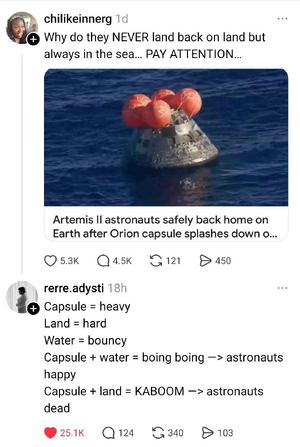
Not so fast my friend: The Russian Cosmonauts always landed on land, except for one emergency landing. According to Google:
Soviet and Russian cosmonauts traditionally land their spacecraft on land (the steppe of Kazakhstan) rather than splashing down in the ocean, unlike early American missions. This approach was chosen due to limited, inhospitable northern water access, vast uninhabited land areas, and the desire to avoid navigating international waters during the Cold War.
Discover MagazineDiscover Magazine +2
Key details regarding Soviet/Russian land landings:
  • The Method: The Soyuz capsule uses a combination of parachutes and solid propellant rockets (the "Elburs" soft-landing system) to create a controlled, yet often firm, landing on the ground.
  • Targeted Areas: Landings are targeted on flat, open, and sparsely inhabited areas, primarily in Kazakhstan, to avoid hazards.
  • Contingencies: While designed for land, the capsules are capable of emergency water landings, such as when Soyuz 23 accidentally landed in a frozen lake in 1976.
  • Recovery: Unlike in-water capsule recovery, land landings allow for immediate access, though specialized teams are needed to traverse the rugged, remote terrain.
    QuoraQuora +4
 

Similar threads

  • Article Article
    • Like
Replies
3
Views
161
    • Like
Replies
2
Views
90
Replies
2
Views
318
🧑‍🤝‍🧑 / 🏡 Shame on me
Replies
5
Views
3K
🧑‍🤝‍🧑 / 🏡 Shoplifter!
    • Like
Replies
18
Views
233
Back
Top Bottom