
One of the toughest things to do on a campus like the University of Alabama’s is to keep a secret, especially when it comes to something regarding football.
A player gets hurt it may be on Internet message boards before practice is even over. Someone does something illicit there could be a photo on nearly every cell phone within minutes. Even a rumor, true or completely baseless, can spread faster across the Capstone than the most aggressive of wildfires.
Yet somehow, someway, this was kept under cover for months. Even though Crimson Tide fans have been aware since January 7, 2010, after Alabama defeated Texas at the Rose Bowl 37-21, that a statue of Nick Saban would eventually be unveiled along the Walk of Champions plaza, the sculptor’s identity remained a secret.
Nearly no one knew that it’s been a student who has been literally making history.
“It wasn’t great at times, but I stuck it out,” senior Jeremy Davis said about overwhelming nature of being commissioned to create perhaps the most beloved, and hated, object in the state. “There wasn’t a whole lot of pressure because I kind of picked it up pretty quick. The main thing was time.”
Only that just begins to tell the story.
Like the Sabans he hails from a coal-mining family. After graduating from a high school that didn’t have an art department there were jobs as a plumber, on sewer construction, masonry, even at the Mercedes plant -- anything with his hands. Two weeks before becoming a fulltime factory employee Davis decided he’d had enough of the swing shift of two weeks days followed by two weeks nights, and chose to follow his passion.
“I decided I’d go back to school and be happier doing what I want to do and maybe make less money, then be well-off and not be able to enjoy it,” the 27-year-old said.
When he enrolled, Davis had never sculpted or touched Plasticine, the modeling clay that really never dries. But in many ways the prodigy was a natural, just like when he used to draw a squirrel as a 3-year-old.
“Good kid,” Alabama art professor Craig Wedderspoon said. “He likes to fish … maybe a little bit too much.
“Incredibly talented.”
MTM Recognition, which did the other statues outside of Bryant-Denny Stadium – the previous coaches who led the Crimson Tide to a national championship: Wallace Wade, Frank Thomas, Paul W. “Bear” Bryant, and Gene Stallings; and the two players with the flag modeled after Matt Collins and Antoine Caldwell -- again spearheaded the project, but was initially working with photos at its Oklahoma City headquarters.
With all of the statues displaying the coaches in their game-day garb, the pose and attire were decided well in advance with Saban leaning forward in the process of clapping his hands and his mouth open a bit as if he’s being encouraging. Only something just wasn’t right.
“It was a nice looking piece,” said Wedderspoon, the school’s expert on statues who oversaw Davis along with instructor Daniel Livingston. “It just wasn’t exactly the coach.
“Think about what characteristics identify an individual. It’s the squint of the eye, the shape of the finger, the turn of the mouth. It’s the details. Honestly, if you don’t have face-to-face interaction with someone you’re not going to know those details.”
A consensus decision was made to get someone locally involved, who could have access to the coach and devote the necessary time, possibly a student. Only one was qualified enough to attempt such a lavish project and Davis was asked to draw a couple of preliminary sketches, which he did at his mother’s house in West Blocton the night before presenting them.
“(Terry) Saban came into the meeting room, looked at it and just went, ‘Oh, this is what we’re looking for,’” Wedderspoon said. “Jeremy was freaking out of course.”
Davis, who comes from a family of Crimson Tide fans, was commissioned to do more drawings and that’s when the real work began. Before he could even think about making a maquette, which is essentially a model that would be enlarged into the 9-foot final version, he had to get all of Saban’s physical idiosyncrasies and nuances down.
For that, in addition to taking photos from all angles, he had the world’s greatest expert, Mrs. Saban.
“It was small things that she wanted fixed,” Davis said. “I remember on one of the better drawings I didn’t have the shadow on his ear just right, it was off just a little bit. She said that he had very distinct earlobes. His nose didn’t round off enough. It’s amazing how much she knew about this man’s face. I guess if you’ve been married for 40 years you know.
“She’s real, real nice.”
To help with the body and proportions Davis had a classmate, former reserve kicker Adam Hill, stand in as a model, and once the Sabans signed off on the design specifics he began constructing the 3-foot maquette.
He used plywood for the base, aluminum wire armature for the skeleton, wrapped it in paper to thicken the figure and then applied the non-drying clay. When Davis didn’t anticipate the clay being so heavy he lost about 40-50 hours of work going back to reinforce the structure, but that was his only major setback.
“Lesson learned,” he said. “You always want strong armature.”
Meanwhile, due to the secrecy issue, Davis switched studios and everything was kept on a need-to-know basis. If anyone asked what was being worked on they couldn’t say and eventually the maquette was stashed in someone’s house.
He finished the maquette near the end of October, right around Alabama’s bye week last season, and after a corresponding rubber mold was made MTM began turning it into a bronze statue. Davis and Livingston traveled to Oklahoma City to go over everything from the texture of the hair to the transitions between the clothing, knowing that anything smaller than 1/8 of an inch would be lost in the transition.
“In the sculpting process you take the maquette, you scan it and a computer literally cuts out a huge foam core, and then you put a layer of clay on top of that,” Livingston said. “The only problem is, again, you miss all that fine detail that we keep talking about that makes a person a person.
“Craig always talks about this in sculpture class, it’s that last five percent on anything that makes or breaks a piece of work.”
So while fans have been clamoring for the statue’s completion, Wedderspoon says it was essentially done with “lightning speed to do it right.” Under normal circumstances, such a project would have taken at least two to three years to complete whereas this was finished roughly 15 months after Alabama came home with the crystal football.
Then again, under normal circumstances a student would never have been the principal artist, either.
“It’s kind of crazy, something of this magnitude that will affect, not necessarily the art world but the public in general because a lot of people will see that,” Davis said. “I come from a very small town. We don’t even have a red light.”
A player gets hurt it may be on Internet message boards before practice is even over. Someone does something illicit there could be a photo on nearly every cell phone within minutes. Even a rumor, true or completely baseless, can spread faster across the Capstone than the most aggressive of wildfires.
Yet somehow, someway, this was kept under cover for months. Even though Crimson Tide fans have been aware since January 7, 2010, after Alabama defeated Texas at the Rose Bowl 37-21, that a statue of Nick Saban would eventually be unveiled along the Walk of Champions plaza, the sculptor’s identity remained a secret.
Nearly no one knew that it’s been a student who has been literally making history.
“It wasn’t great at times, but I stuck it out,” senior Jeremy Davis said about overwhelming nature of being commissioned to create perhaps the most beloved, and hated, object in the state. “There wasn’t a whole lot of pressure because I kind of picked it up pretty quick. The main thing was time.”
Only that just begins to tell the story.
Like the Sabans he hails from a coal-mining family. After graduating from a high school that didn’t have an art department there were jobs as a plumber, on sewer construction, masonry, even at the Mercedes plant -- anything with his hands. Two weeks before becoming a fulltime factory employee Davis decided he’d had enough of the swing shift of two weeks days followed by two weeks nights, and chose to follow his passion.
“I decided I’d go back to school and be happier doing what I want to do and maybe make less money, then be well-off and not be able to enjoy it,” the 27-year-old said.
When he enrolled, Davis had never sculpted or touched Plasticine, the modeling clay that really never dries. But in many ways the prodigy was a natural, just like when he used to draw a squirrel as a 3-year-old.
“Good kid,” Alabama art professor Craig Wedderspoon said. “He likes to fish … maybe a little bit too much.
“Incredibly talented.”
MTM Recognition, which did the other statues outside of Bryant-Denny Stadium – the previous coaches who led the Crimson Tide to a national championship: Wallace Wade, Frank Thomas, Paul W. “Bear” Bryant, and Gene Stallings; and the two players with the flag modeled after Matt Collins and Antoine Caldwell -- again spearheaded the project, but was initially working with photos at its Oklahoma City headquarters.
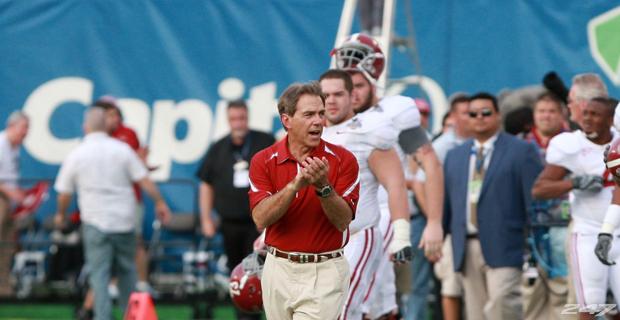
With all of the statues displaying the coaches in their game-day garb, the pose and attire were decided well in advance with Saban leaning forward in the process of clapping his hands and his mouth open a bit as if he’s being encouraging. Only something just wasn’t right.
“It was a nice looking piece,” said Wedderspoon, the school’s expert on statues who oversaw Davis along with instructor Daniel Livingston. “It just wasn’t exactly the coach.
“Think about what characteristics identify an individual. It’s the squint of the eye, the shape of the finger, the turn of the mouth. It’s the details. Honestly, if you don’t have face-to-face interaction with someone you’re not going to know those details.”
A consensus decision was made to get someone locally involved, who could have access to the coach and devote the necessary time, possibly a student. Only one was qualified enough to attempt such a lavish project and Davis was asked to draw a couple of preliminary sketches, which he did at his mother’s house in West Blocton the night before presenting them.
“(Terry) Saban came into the meeting room, looked at it and just went, ‘Oh, this is what we’re looking for,’” Wedderspoon said. “Jeremy was freaking out of course.”
Davis, who comes from a family of Crimson Tide fans, was commissioned to do more drawings and that’s when the real work began. Before he could even think about making a maquette, which is essentially a model that would be enlarged into the 9-foot final version, he had to get all of Saban’s physical idiosyncrasies and nuances down.
For that, in addition to taking photos from all angles, he had the world’s greatest expert, Mrs. Saban.
“It was small things that she wanted fixed,” Davis said. “I remember on one of the better drawings I didn’t have the shadow on his ear just right, it was off just a little bit. She said that he had very distinct earlobes. His nose didn’t round off enough. It’s amazing how much she knew about this man’s face. I guess if you’ve been married for 40 years you know.
“She’s real, real nice.”
To help with the body and proportions Davis had a classmate, former reserve kicker Adam Hill, stand in as a model, and once the Sabans signed off on the design specifics he began constructing the 3-foot maquette.
He used plywood for the base, aluminum wire armature for the skeleton, wrapped it in paper to thicken the figure and then applied the non-drying clay. When Davis didn’t anticipate the clay being so heavy he lost about 40-50 hours of work going back to reinforce the structure, but that was his only major setback.
“Lesson learned,” he said. “You always want strong armature.”
Meanwhile, due to the secrecy issue, Davis switched studios and everything was kept on a need-to-know basis. If anyone asked what was being worked on they couldn’t say and eventually the maquette was stashed in someone’s house.
He finished the maquette near the end of October, right around Alabama’s bye week last season, and after a corresponding rubber mold was made MTM began turning it into a bronze statue. Davis and Livingston traveled to Oklahoma City to go over everything from the texture of the hair to the transitions between the clothing, knowing that anything smaller than 1/8 of an inch would be lost in the transition.
“In the sculpting process you take the maquette, you scan it and a computer literally cuts out a huge foam core, and then you put a layer of clay on top of that,” Livingston said. “The only problem is, again, you miss all that fine detail that we keep talking about that makes a person a person.
“Craig always talks about this in sculpture class, it’s that last five percent on anything that makes or breaks a piece of work.”
So while fans have been clamoring for the statue’s completion, Wedderspoon says it was essentially done with “lightning speed to do it right.” Under normal circumstances, such a project would have taken at least two to three years to complete whereas this was finished roughly 15 months after Alabama came home with the crystal football.
Then again, under normal circumstances a student would never have been the principal artist, either.
“It’s kind of crazy, something of this magnitude that will affect, not necessarily the art world but the public in general because a lot of people will see that,” Davis said. “I come from a very small town. We don’t even have a red light.”


