
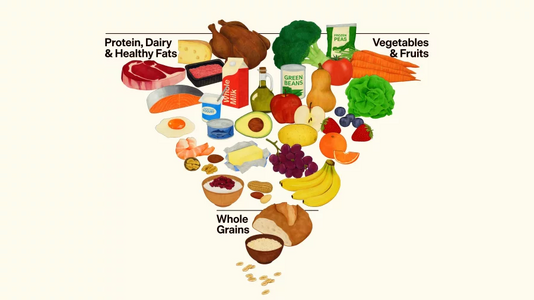
🧑‍🤝‍🧑 / 🏡 The new Food Pyramid released by the USDA.

TerryP

Successfully wasting your time since...
Staff
1767857847005.png


Health Secretary Robert F. Kennedy Jr. has announced new dietary guidelines for Americans focused on promoting whole foods, proteins and healthy fats.

At a press conference Wednesday, the administration unveiled a new food pyramid with red meat, cheese, vegetables and fruits pictured at the top.

Kennedy described the guidelines as the most significant reset on nutrition policy in history, calling for an end to policies that promote highly refined foods that are harmful to health.

The guidelines will set limits on added sugar and encourage diets that include meat and dairy.

"Protein and healthy fats are essential and were wrongly discouraged in prior dietary guidelines," Kennedy said. "We are ending the war on saturated fats."

As an introduction to the new guidelines, Kennedy and Agriculture Secretary Brooke Rollins called for a "dramatic reduction" in the consumption of "highly processed foods laden with refined carbohydrates, added sugars, excess sodium, unhealthy fats, and chemical additives."

"This approach can change the health trajectory for so many Americans," they wrote, pointing out that more than 70% of American adults are overweight or obese due to a diet that has "become reliant on highly processed foods and coupled with a sedentary lifestyle."

For years, Americans have been advised to limit saturated fat, and the new pyramid is facing criticism.

"I'm very disappointed in the new pyramid that features red meat and saturated fat sources at the very top, as if that's something to prioritize. It does go against decades and decades of evidence and research," says Christopher Gardner, a nutrition expert at Stanford University. He was a member of the Dietary Guidelines Advisory Committee, which reviewed all the nutrition evidence. He's in favor of increasing plant-based sources of protein, such as beans, rather than emphasizing animal protein.

Both the American Heart Association and the Academy of Nutrition and Dietetics, which includes thousands of nutrition professionals, point to evidence that excess saturated fat is linked to heart disease. And the new guidelines do still include a long held recommendation to limit saturated fat to 10% of your daily calories.

The guidelines also elevate cheese and other dairy to the top of the pyramid, paving the way for the option of full-fat milk and other dairy products in school meals. There's growing evidence, based on nutrition science, that dairy foods can be beneficial.

"It's pretty clear that overall milk and cheese and yogurt can be part of a healthy diet," says Dariush Mozaffarian, a cardiologist, a public health scientist and the director of the Food is Medicine Institute at Tufts University. "Both low-fat and whole-fat dairy versions of milk, cheese and yogurt have been linked to lower cardiovascular risk," he says.

"What's quite interesting is that the fat content doesn't seem to make a big difference," Mozaffarian says.


Mozaffarian says he supports the recommendations to lower consumption of highly processed foods. "Highly processed foods are clearly harmful for a range of diseases, so to have the U.S. government recommend that a wide class of foods be eaten less because of their processing is a big deal and I think a very positive move for public health," he says.

While the guidelines do not use the word ultra-processed, they do stress that Americans should eat, "real food that nourishes the body." And they recommend no amount of added sugar for children under the age of 10.

Though most Americans don't read the dietary guidelines, they are highly influential in determining what's served in school meals and on military bases, as well as what's included in federal food aid for mothers and infants, as the guidelines set targets for calories and nutrients.

 
And here is where it gets funny:

Screenshot 2026-01-08 2.43.15 AM.png
"I'm very disappointed in the new pyramid that features red meat and saturated fat sources at the very top, as if that's something to prioritize. It does go against decades and decades of evidence and research," says Christopher Gardner, a nutrition expert at Stanford University. He was a member of the Dietary Guidelines Advisory Committee, which reviewed all the nutrition evidence. He's in favor of increasing plant-based sources of protein, such as beans, rather than emphasizing animal protein.


Meet Prof. Gardner:

Bio​

For the past 20 years most of my research has been focused on investigating the potential health benefits of various dietary components or food patterns using randomized controlled trials. The interventions have involved vegetarian diets, soy, garlic, omega-3 fats/fish oil/flax oil, antioxidants, Ginkgo biloba, and popular weight loss diets. These trials have studied outcomes that include weight, blood lipids and lipoproteins, inflammatory markers, glucose, insulin, and body composition. Most of these trials have been NIH-funded. The most impactful of these is an NIH-funded weight loss diet study - DIETFITS (Diet Intervention Examining The Factors Interacting with Treatment Success) that involved randomizing 609 generally healthy, overweight/obese adults for one year to either Healthy Low-Fat or Healthy Low-Carb diet (JAMA, 2018).

In the past few years the interests of my research group have shifted to include three additional areas of inquiry. One of these is Stealth Nutrition. The central hypothesis driving this is that in order for more effective and impactful dietary improvements to be realized, health professionals need to consider adding non-health related approaches to their toolbox of strategies. Examples would be connections between food and 1) global warming and climate change, 2) animal rights and welfare, and 3) human labor abuses (e.g., slaughterhouses). An example is a summer Food and Farm Camp run in collaboration with the Santa Clara Unified School District since 2011. Every year ~125 kids 5-14 years of age come for a 1-week summer camp to tend, harvest, chop, cook, and eat vegetables...and play because it is summer camp! The objective is to study the factors influencing the behaviors and preferences that lead to maximizing vegetable consumption in kids.
 
BTW, you see "Rhenborg?" I can't tell you how I specifically know this: it's related to Nutrilite. I can't remember how nor why I know that.

And, if you didn't know...

Nutrilite is related to Amway.
 
And here is where it gets funny:


Meet Prof. Gardner:

Bio​

For the past 20 years most of my research has been focused on investigating the potential health benefits of various dietary components or food patterns using randomized controlled trials. The interventions have involved vegetarian diets, soy, garlic, omega-3 fats/fish oil/flax oil, antioxidants, Ginkgo biloba, and popular weight loss diets. These trials have studied outcomes that include weight, blood lipids and lipoproteins, inflammatory markers, glucose, insulin, and body composition. Most of these trials have been NIH-funded. The most impactful of these is an NIH-funded weight loss diet study - DIETFITS (Diet Intervention Examining The Factors Interacting with Treatment Success) that involved randomizing 609 generally healthy, overweight/obese adults for one year to either Healthy Low-Fat or Healthy Low-Carb diet (JAMA, 2018).

In the past few years the interests of my research group have shifted to include three additional areas of inquiry. One of these is Stealth Nutrition. The central hypothesis driving this is that in order for more effective and impactful dietary improvements to be realized, health professionals need to consider adding non-health related approaches to their toolbox of strategies. Examples would be connections between food and 1) global warming and climate change, 2) animal rights and welfare, and 3) human labor abuses (e.g., slaughterhouses). An example is a summer Food and Farm Camp run in collaboration with the Santa Clara Unified School District since 2011. Every year ~125 kids 5-14 years of age come for a 1-week summer camp to tend, harvest, chop, cook, and eat vegetables...and play because it is summer camp! The objective is to study the factors influencing the behaviors and preferences that lead to maximizing vegetable consumption in kids.
The highlighted areas you point to are good. I know to people of a particular political ideology NIH is a boogeyman, but they’ve done excellent research over the past several decades.

Stealth nutrition is good. The last bit that you highlight are all good ideas in the approach to food. Again I know to some of a particular political ideology those are all bad words, but it’s a great idea to add those to the health “toolbox”.

I sent an email to a friend who’s a PhD nutrition scientist to gauge his viewpoint on the new pyramid out of curiosity. I’m not a nutrition scientist so I don’t have an opinion one way or the other. I don’t get my nutrition ideas from the government and really don’t from a dude that said something was eating his brain.
 
Idiocracy_food-pyramid10.png
 
The highlighted areas you point to are good. I know to people of a particular political ideology NIH is a boogeyman, but they’ve done excellent research over the past several decades.
Step back six feet and take another look. People trust the NIH as much as one would trust Dicaprio around their teenage daughter: zero credibility.

Stealth nutrition is good. The last bit that you highlight are all good ideas in the approach to food. Again I know to some of a particular political ideology those are all bad words, but it’s a great idea to add those to the health “toolbox”.
Now you are losing a little credibility. Labor, as one example (#3.) Who cuts the beef has an effect on who eats the beef? That's just down right stupid. If Juan cuts it my diet is different from when John cuts it? The US has an obesity problem because of global warming? At least the bar was set low with Juan and John. The welfare of a species of animal is related to Benita eating junk food? The dude is playing Limbo with science and education and he's doing well moving the bar lower, and lower, and lower.
I’m not a nutrition scientist so I don’t have an opinion one way or the other.
Is this the caveat to the first two paragraphs? 🙃 Those two were just spent voicing your non-existant opinion? 🍻
 
It sounds like a crazy conspiracy theory that key personnel within the federal government was bribed (or maybe blackmailed) to mislead the general public (and literally poison them) to help subsidize the processed food industry and domestic grain producers. Our leaders would never do such a thing. :sneaky:
 
It sounds like a crazy conspiracy theory that key personnel within the federal government was bribed (or maybe blackmailed) to mislead the general public (and literally poison them) to help subsidize the processed food industry and domestic grain producers. Our leaders would never do such a thing. :sneaky:
Stealth Nutrition 1.0. We're now entering a new stage of development.

I think I have it: CO2 is bad and I should grow and eat more veggies.
 
I eat red meat (hamburgers, steaks, beef stew, etc.), pork (pork chops, bacon, pulled bbq pork, etc.), chicken (in salads, on a sandwich, fried, boiled, grilled, broiled, baked, etc.), turkey (same as chicken), and fist (fried, grilled, baked) for meats.
I eat plenty of vegetables.
I eat plenty of grains.

I drink a cup of coffee every morning
I drink an espresso every day when I get home from work
I drink a glass of sweet tea with supper
I drink an occasional Dr Pepper (maybe once every 2 weeks or so)
The rest is water (drink it all day at work and when at home on the weekends)

I eat/drink what I like, plain and simple.

So I don't need a pyramid (scheme) to tell me what to eat or drink.
 
I eat red meat (hamburgers, steaks, beef stew, etc.), pork (pork chops, bacon, pulled bbq pork, etc.), chicken (in salads, on a sandwich, fried, boiled, grilled, broiled, baked, etc.), turkey (same as chicken), and fist (fried, grilled, baked) for meats.
I eat plenty of vegetables.
I eat plenty of grains.

I drink a cup of coffee every morning
I drink an espresso every day when I get home from work
I drink a glass of sweet tea with supper
I drink an occasional Dr Pepper (maybe once every 2 weeks or so)
The rest is water (drink it all day at work and when at home on the weekends)

I eat/drink what I like, plain and simple.

So I don't need a pyramid (scheme) to tell me what to eat or drink.
Seems like a dumbass way to spend money when the average person knows that whole foods are healthier than stuff out of a box but what do I know?
 
Step back six feet and take another look. People trust the NIH as much as one would trust Dicaprio around their teenage daughter: zero credibility.


Now you are losing a little credibility. Labor, as one example (#3.) Who cuts the beef has an effect on who eats the beef? That's just down right stupid. If Juan cuts it my diet is different from when John cuts it? The US has an obesity problem because of global warming? At least the bar was set low with Juan and John. The welfare of a species of animal is related to Benita eating junk food? The dude is playing Limbo with science and education and he's doing well moving the bar lower, and lower, and lower.

Is this the caveat to the first two paragraphs? 🙃 Those two were just spent voicing your non-existant opinion? 🍻
People don’t trust the NIH, you mean people on the right. Although you’re probably right because the left doesn’t trust anything this administration has their fingers on, but overall people not Trumpers trust science.

Here let’s help with yours and I’s debates/arguments just to save time from this silly back and forth where you say I don’t know what I’m talking about and where you say I lose credibility blah blah blah, you disagree with everything and everybody that goes against this administration in any manner, just to save time.

But, I’m wondering if you read the article or just saw words you disagree with and decided to highlight them and say some shit? Because his ideas in regards to global warming, animal welfare, and human labor abuses are important, but again you don’t like the words and don’t agree with anything remotely to that, so it’s wrong and you’re right.
 
What box are you referring to?

Also, since it's my money, I figure I can spend it however I want.
I'm saying drawing the whole pyramid is a waste of government money. Most of us know eating meat and whole fruits and vegetables is healthier.

Was agreeing with your last sentence, "So I don't need a pyramid (scheme) to tell me what to eat or drink."
Should've only included that in my reply.
 
People don’t trust the NIH, you mean people on the right. Although you’re probably right because the left doesn’t trust anything this administration has their fingers on, but overall people not Trumpers trust science.

Here let’s help with yours and I’s debates/arguments just to save time from this silly back and forth where you say I don’t know what I’m talking about and where you say I lose credibility blah blah blah, you disagree with everything and everybody that goes against this administration in any manner, just to save time.

But, I’m wondering if you read the article or just saw words you disagree with and decided to highlight them and say some shit? Because his ideas in regards to global warming, animal welfare, and human labor abuses are important, but again you don’t like the words and don’t agree with anything remotely to that, so it’s wrong and you’re right.
So ancient cities like Thonis-Heracleion and Pavlopetri are underwater, according to scientists, because of sea level rise and earthquakes. If sea levels have been rising since those times, what was the cause then?
 
I'm saying drawing the whole pyramid is a waste of government money. Most of us know eating meat and whole fruits and vegetables is healthier.

Was agreeing with your last sentence, "So I don't need a pyramid (scheme) to tell me what to eat or drink."
Should've only included that in my reply.
Ah...OK. And yes, I agree that it's a waste of government money. But that's all they know what to do with money.
 
Back
Top Bottom